The case, chapter by chapter
0:00
How does a ban turn into a bill?
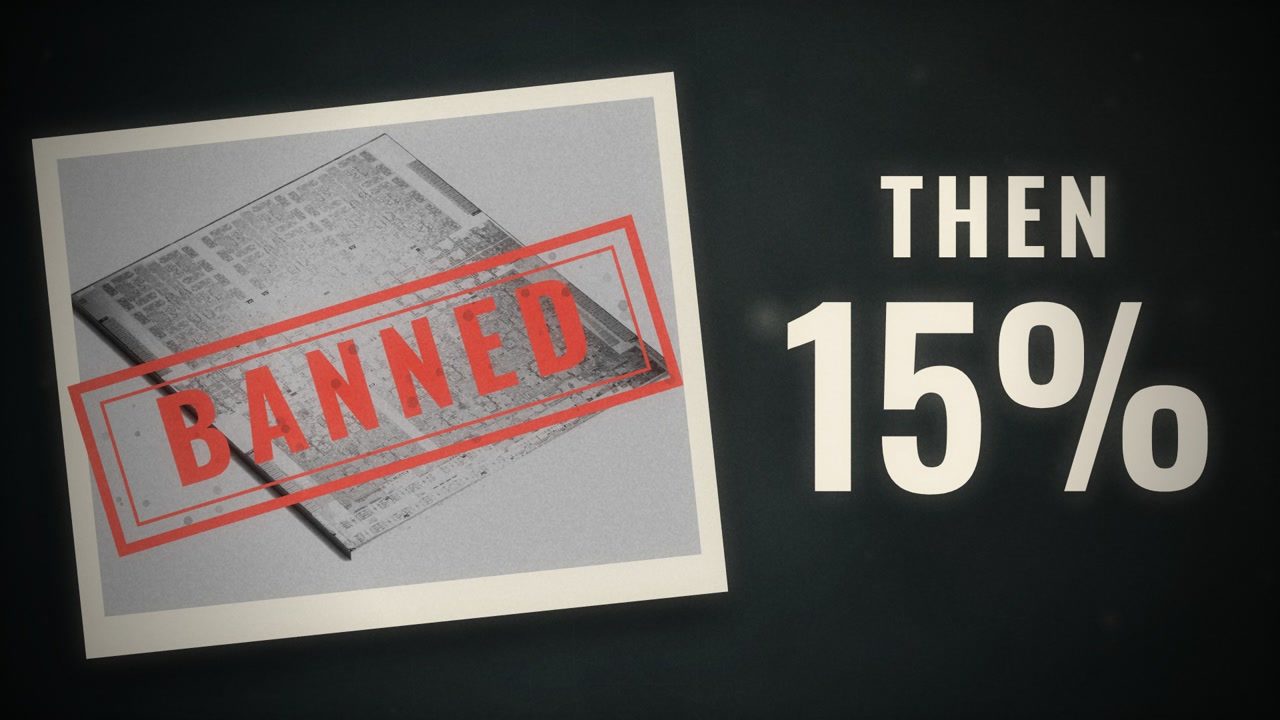
In August 2025, the press reported an unusual deal. Two American chip companies, Nvidia and AMD, would pay the United States government 15% of what they earned selling certain chips to China [5].
President Trump confirmed it at a press conference on Aug. 11, 2025, according to the Associated Press. It was not a law. Rep. Krishnamoorthi, quoted by the AP, called it "a dangerous misuse of export controls." [5]
Three years earlier, for chips like these, Washington's default answer was no [1]. Now the answer had a price.
This is the story of how a ban turned into a bill. It ends with a line in Nvidia's own quarterly report [3].
0:49
Why would a government care about a video game chip?
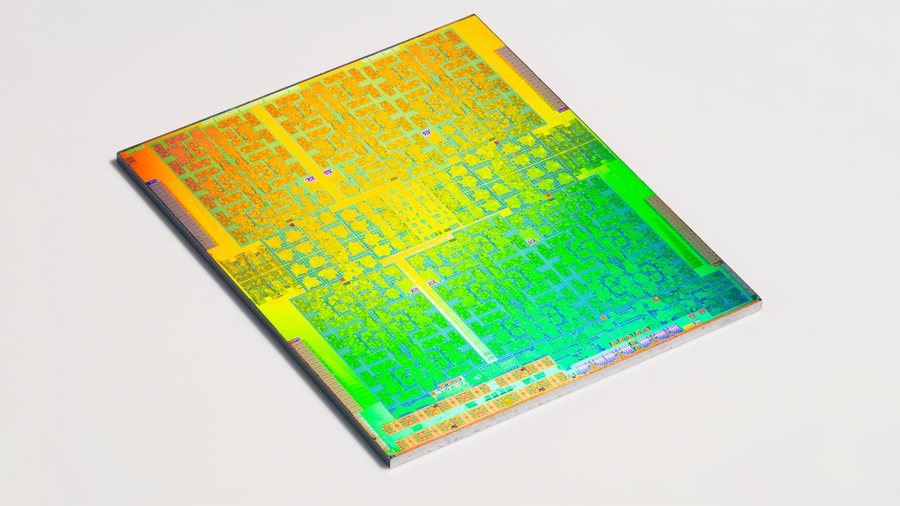
In 1993, in Santa Clara, California, three engineers founded a company to make chips for video games. One of them is Jensen Huang. They called it Nvidia [10].
Nvidia designs its chips and lets someone else build them. Today the newest ones come out of one company in Taiwan, TSMC. One country draws the chip. Another builds it [10].
In 2006 Nvidia released CUDA, a tool that lets programmers use a graphics chip for general computing. Six years later, a team at the University of Toronto entered a contest to recognize images. Their network trained for five to six days on two Nvidia graphics cards. It won. A graphics chip had become an AI chip [10].
This background comes from encyclopedia and press accounts. We did not read it at a primary source.
1:38
What did the October 2022 rule say?
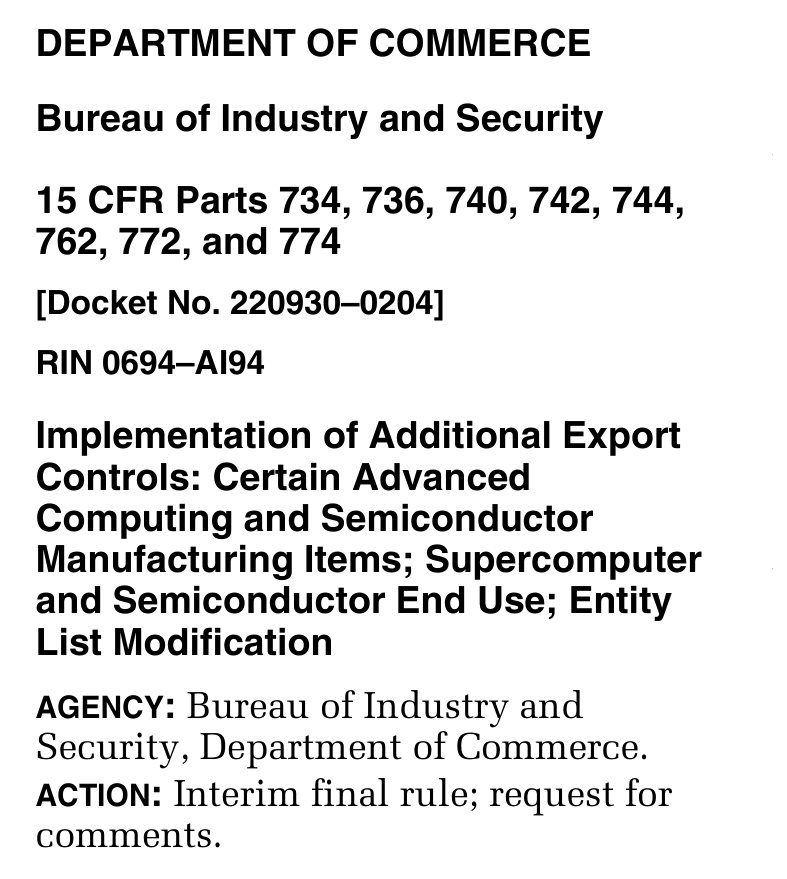
In October 2022, the Commerce Department published a rule in the Federal Register. It runs 30 pages. Advanced AI chips bound for China now needed a license, and the default answer was no [1].
The stated reason: these chips could power military supercomputers [1]. The rule drew a line: a data speed of 600 gigabytes per second. And a line can be measured [1].
Swipe sideways to read the full line.
2:35
Why were the rules not finished?
Public reports said Nvidia designed two chips, the A800 and the H800, to sit just under that line [11].
A year later, Washington drew a second line, called performance density, meant to stop buyers from stacking smaller chips to reach the same power. The same day, Nvidia told investors that seven of its products were now covered. The H800 is one of them [11].
In January 2025, Washington tried something bigger: a rule that would have required licenses for data center chips across the whole world, with countries split into three tiers. In May, the government said it would rescind it and write a replacement [11]. Nvidia's latest report says the scope and timing of that replacement remain uncertain [3].
3:00
What happened to the H20?
So Nvidia sold China another chip, the H20, made to fit under the limits, according to public reports [11]. In April 2025, the government said that one needed a license too. Nvidia told investors to expect a charge of up to approximately $5.5 billion [4].
That was the forecast. The accounts came later. The company's reports record a charge of $4.5 billion, for unsold H20 inventory and purchase commitments [3]. Not a number in a warning, but a line in the books.
3:32
What did Jensen Huang say in Taipei?
A month later, Jensen Huang was in Taipei. On May 21, 2025, according to Reuters and CNBC, he said: "The export control was a failure." [8]
That is his view, not a ruling, and Washington does not share it. An unnamed senior administration official said there was a consensus to keep restricting China's AI ambitions, Reuters reported. That is one report and one unnamed source [8].
3:56
How did a no become a maybe?
First, Washington approved some H20 sales [5]. Beijing did not applaud. On July 18, 2025, China's Commerce Ministry said it "firmly opposes this" and urged the United States to drop zero-sum thinking, China Daily and CGTN reported [9].
Then came the 15% [5]. By December, the press reported a new number for a newer chip, the H200: 25% [6]. And on Jan. 15, 2026, a new rule took effect [2]. In the film's words, that is how a ban turns into a bill: a chip that needed a no can now get a maybe, for a share of the money.
4:33
What does the January 2026 rule require?
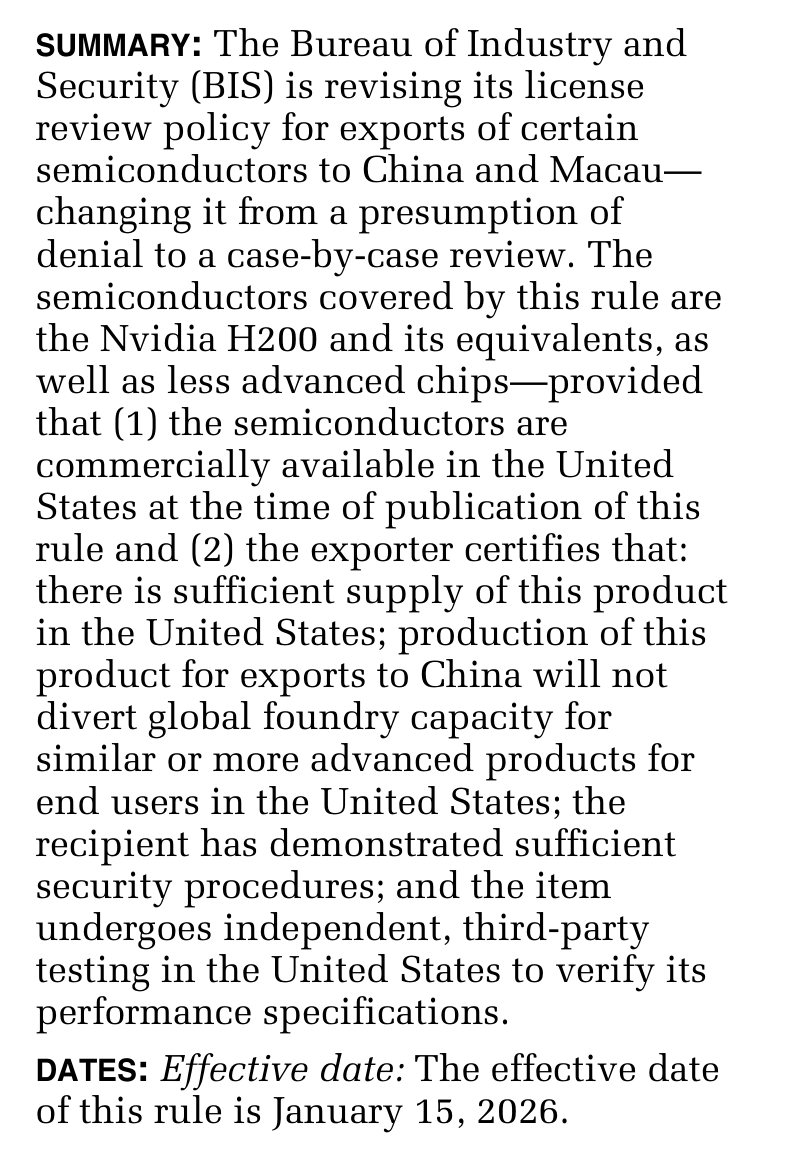
The rule is short. Its summary says the Commerce Department is changing its license review policy for the Nvidia H200 and its equivalents, as well as less advanced chips, for China and Macau, from a presumption of denial to case-by-case review [2].
But read the conditions. They are not small. The exporter must certify that there is sufficient supply in the United States, and that production for China will not divert foundry capacity from American buyers. Shipments to China cannot exceed 50% of what is shipped to customers in the United States. The recipient must have shown sufficient security procedures. And the item must undergo independent third-party testing in the United States [2].
A maybe, with five conditions attached. In our reading, it is no longer only a ban on a product. It is a permission, with a checklist, written by a government.
Swipe sideways to read the full line.
5:22
What is the 25% tariff at the border?
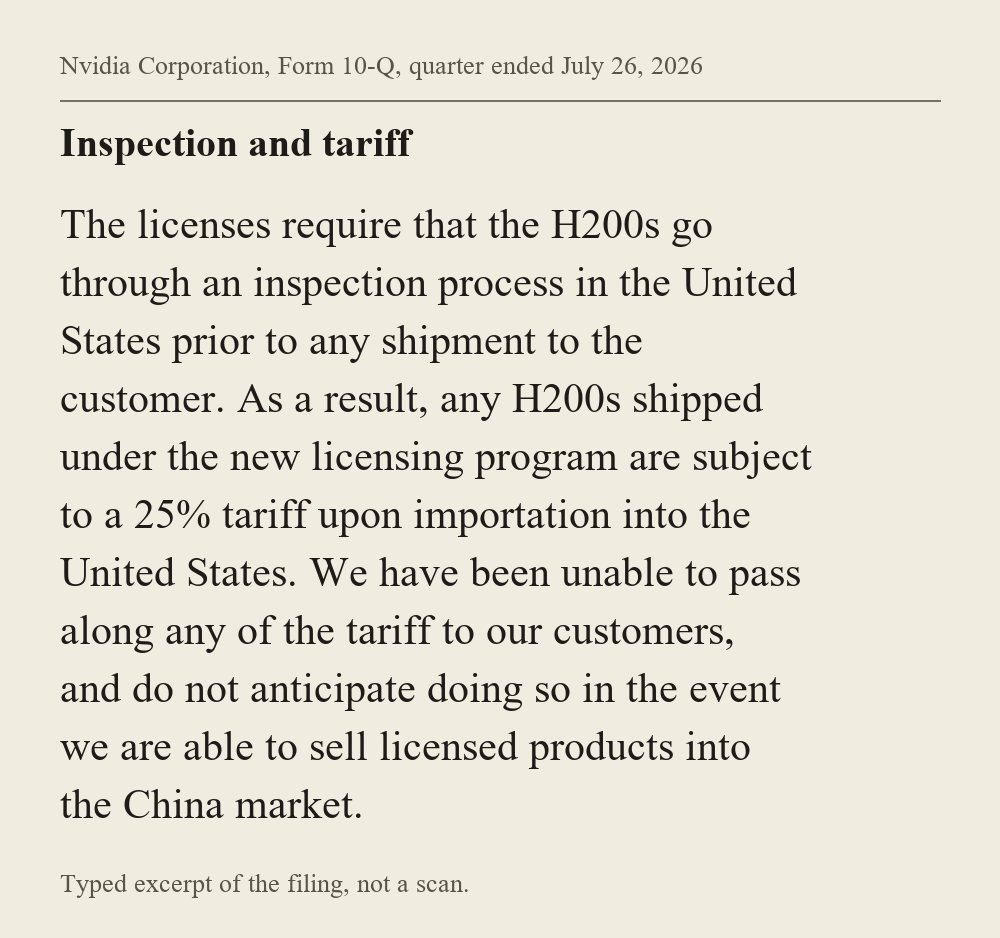
There is one more detail hidden in that checklist. Every chip must pass through the United States for testing [2]. Nvidia's quarterly report explains what follows: chips that enter for inspection are subject to a 25% tariff on import [3].
That appears to be the 25% the press described. That is our inference: the filing does not say so. If it is right, it is a tax at a border, not a payment in a deal. Nvidia says it has been unable to pass any of that tariff on to its customers [3].
The same report says that, for the earlier H20, licenses were granted from August 2025. But Beijing restricted those sales too, and Nvidia could not sell its H20 inventory [3]. So the first maybe had already failed once.
Swipe sideways to read the full line.
6:07
Is the rule a wall, a toll or a permission?
Supporters of the limits say the most powerful chips should never reach a rival's military. Others say sell the older chips, and the world builds on American technology. Both sides say they are protecting the country. These are positions reported without names.
And the fight is not over. In November 2026, the press reported that Congress is pushing three measures for the next defense bill. One would give Congress a say in approving advanced chip exports. Another would require chips to carry location checks, to help stop smuggling. The third presses the Netherlands and Japan to stop selling chipmaking machines to China [7].
Jensen Huang has publicly opposed the first. Beijing has said it rejects the negative content about China. None of this is law yet. The press reports a coming summit between the two presidents [7]. That means the same chip may be a bargaining piece in a negotiation and a limit in a law at the same time.
7:08
What did the maybe actually produce?
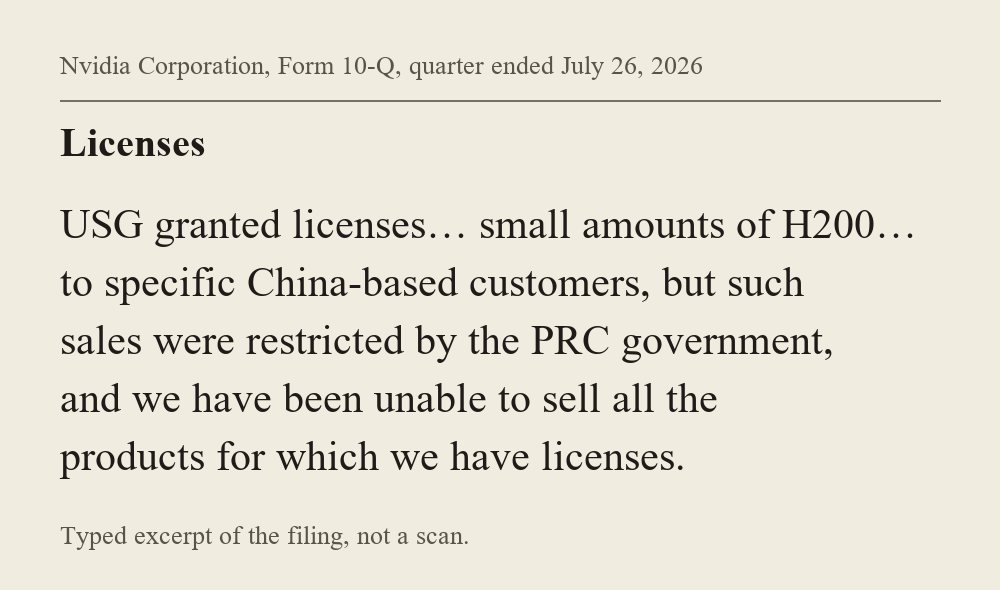
Nvidia's quarterly report, for the period ending July 26, 2026, says the American government did grant licenses to ship small amounts of the H200 to specific customers in China. But, in its words, those sales were restricted by the Chinese government [3].
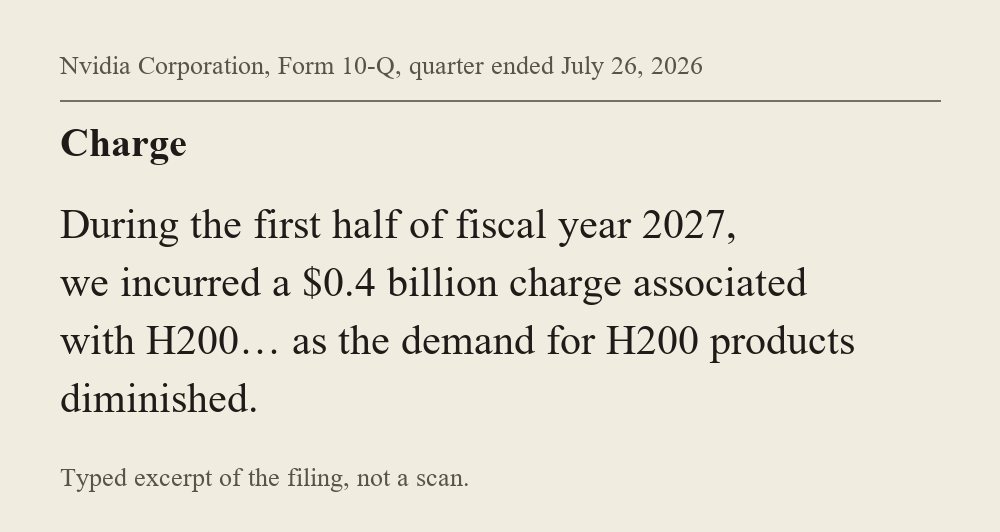
So Nvidia took a charge of $0.4 billion. And the shipments it did make were less than 1% of its data center revenue in the most recent quarter [3].
Swipe sideways to read the full line.
Swipe sideways to read the full line.
7:40
Did a chip become a weapon?
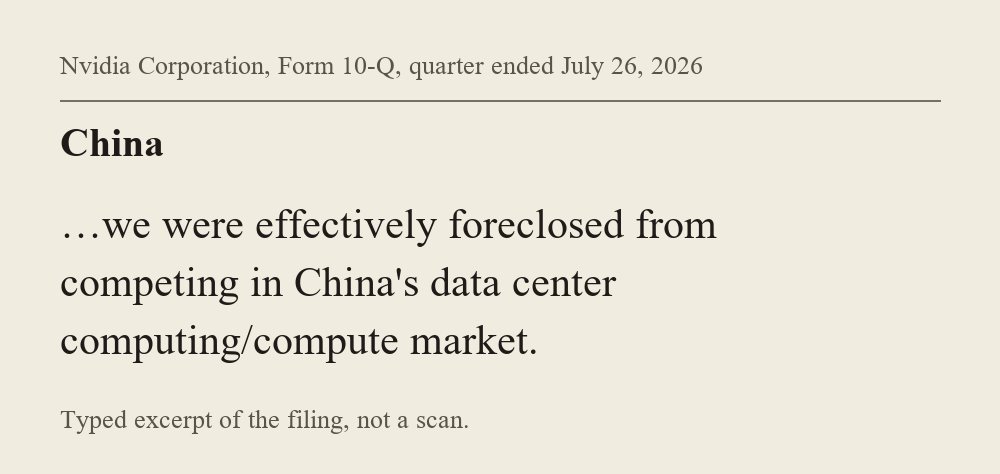
Washington opened the door. Beijing held it shut. And the company says it is "effectively foreclosed" from China's data center market [3].
The company says the cost does not stop there. Its absence from that market, it writes, helped competitors build larger developer and customer ecosystems to challenge it worldwide [3]. A rule written to limit China's access, and the company that makes the chip warns it may be helping its rivals.
So did a chip become a weapon? No court has said so. The film's answer is that two governments now treat it like one. And what happens when the next chip is ready, before the next rule is written?
Swipe sideways to read the full line.