The case, chapter by chapter
0:00
How do 14,000 files become one count, and then one pardon?
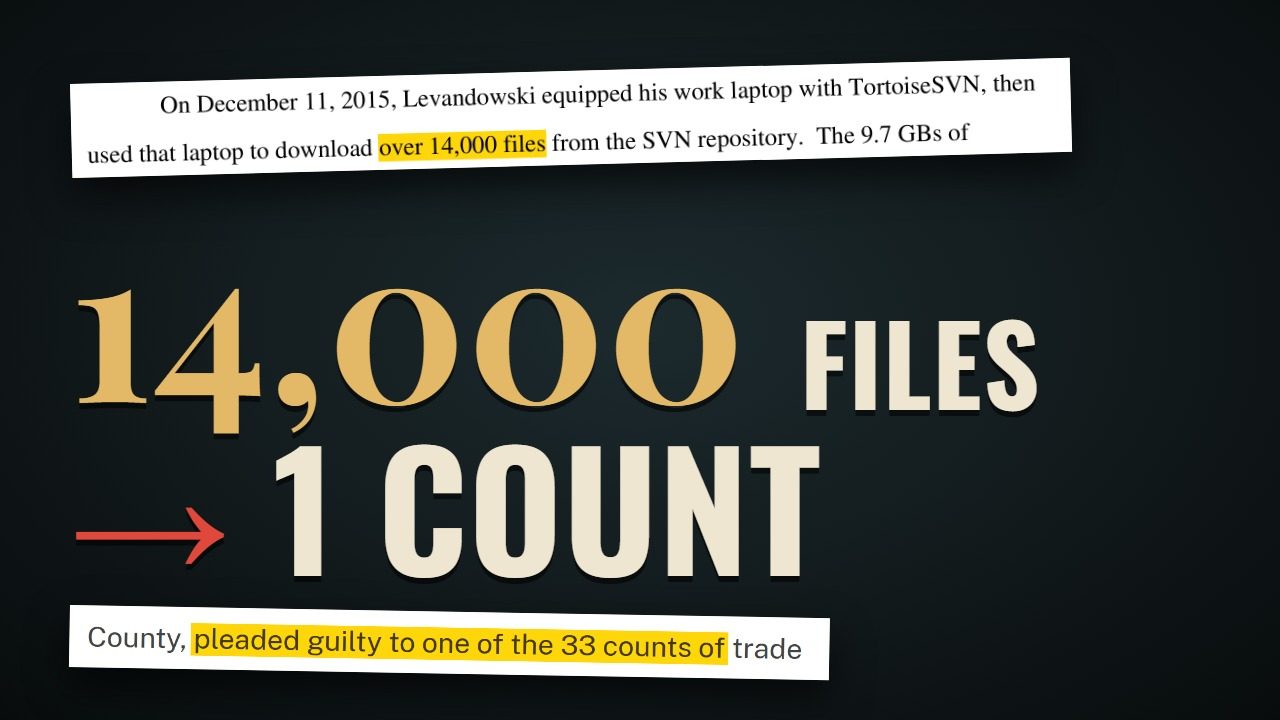
On Dec. 11, 2015, a Google engineer installed a special program on his work laptop. A federal judge later wrote that he then downloaded more than 14,000 files from a protected server, 9.7 gigabytes. Three days later, the judge wrote, he attached a portable data transfer device to that laptop for about eight hours [2]. More than four and a half years after that, the same judge sentenced him [5].
His name is Anthony Levandowski. He had helped build Google's self-driving car, and he left in January 2016. Three questions run through the case: who built the technology, who took the files, and who paid the bill. Two details are often left out: what the single count was actually about, and something a judge said about him that a president later repeated [1][2][5][6].
1:12
What was the technology, and how did Otto and the lawsuit begin?
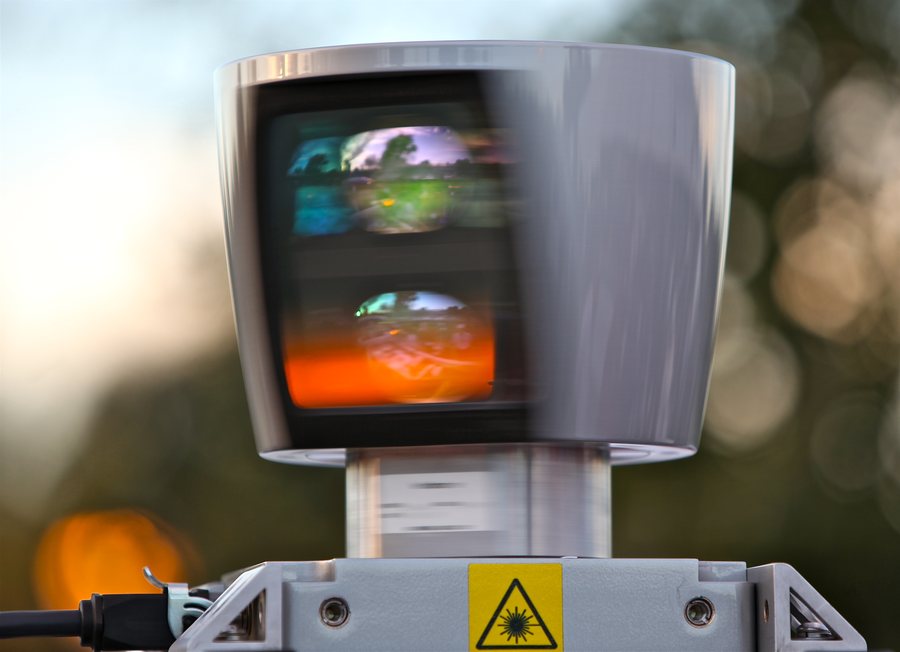
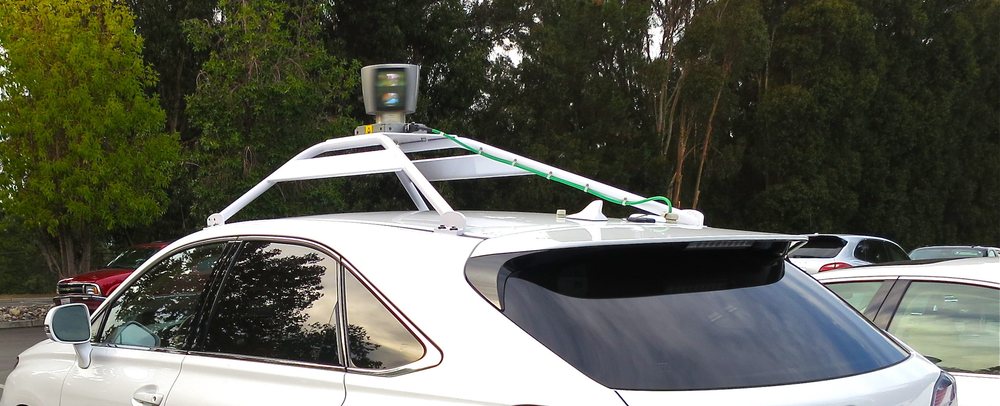
The technology was a laser sensor called lidar. It fires laser pulses and measures what bounces back, to build a three-dimensional picture of the road. Google started its self-driving car project in 2009, according to its complaint, and by 2016 it had become a company called Waymo [1].
On Jan. 15, 2016, Levandowski formed a new company, Ottomotto. Twelve days later, he resigned from Google without notice. In August, Uber bought Otto for about $680 million and put him in charge of its self-driving cars. He reported directly to Uber's chief executive [1][2].
On Feb. 23, 2017, Waymo sued Uber and Otto. According to its complaint, a supplier copied Waymo on an email, apparently by accident. Attached were drawings of what looked like an Uber circuit board, and Waymo said it resembled its own. That is an allegation [1].
2:32
What did the judge's two orders of May 2017 say?
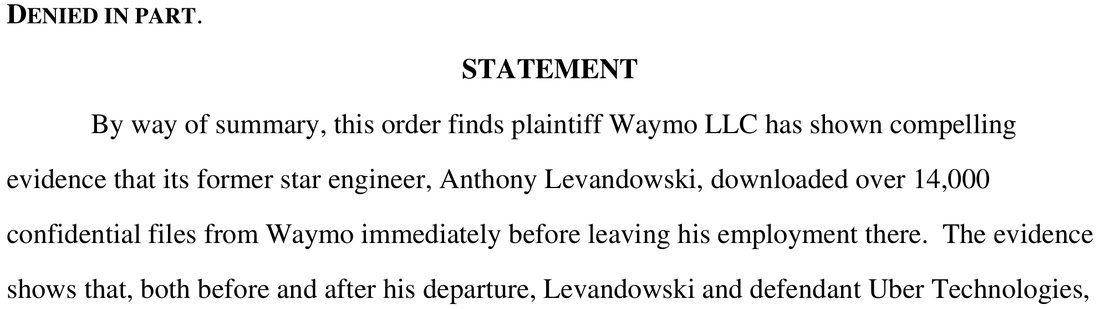
Judge William Alsup read the record, and on May 11, 2017 he issued two orders. The first said Waymo had shown compelling evidence that its former engineer had downloaded over 14,000 confidential files just before leaving. The judge added that Uber likely knew, or at least should have known, he had taken them [2].
Uber's side said that, in all the searches so far, none of the files had been found on its servers. The judge wrote that the evidence still indicated that at least some information from those files had seeped into Uber's own lidar work. Levandowski offered no statement. He asserted his Fifth Amendment right against self-incrimination. The order told Uber to take him off its lidar work, and to get any downloaded files back to Waymo by May 31 [2].
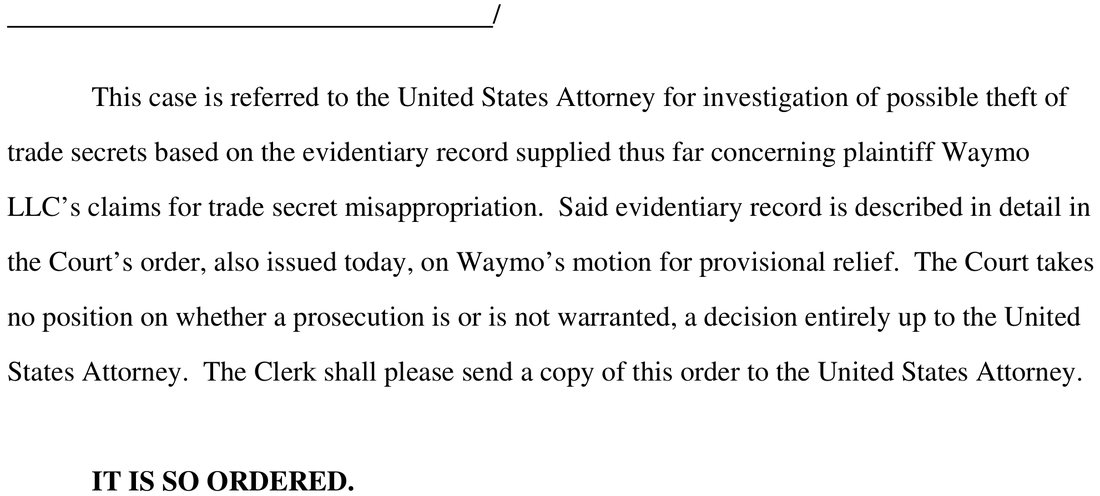
The second order was a single page. It sent the case to the United States Attorney "for investigation of possible theft of trade secrets," and then added that the Court "takes no position on whether a prosecution is or is not warranted." These were provisional findings made for a motion, and the defendants disputed them [2][3].
Swipe sideways to read the full line.
Swipe sideways to read the full line.
3:58
Why did the trial never reach a verdict?
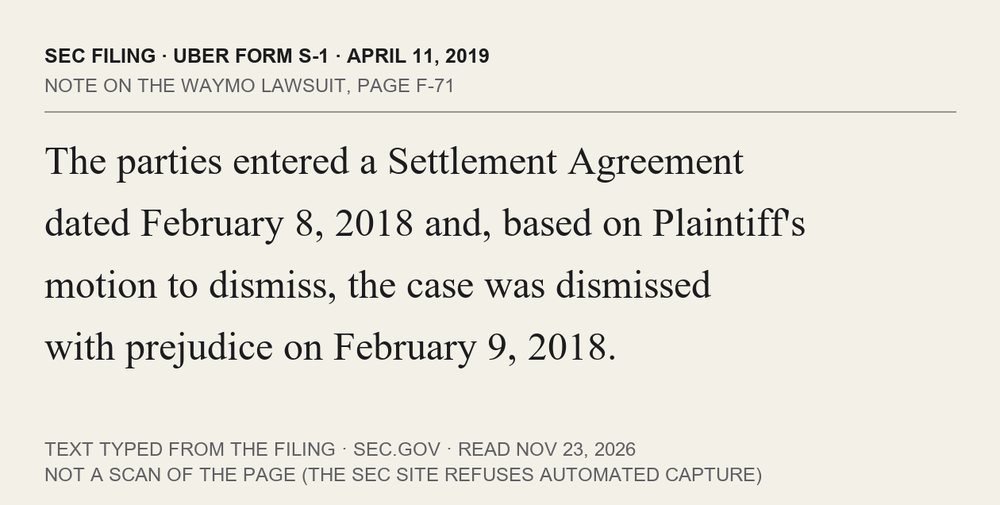
The trial began in February 2018. It never reached a verdict. Uber and Waymo signed a settlement agreement dated Feb. 8, and the next day the case was dismissed with prejudice [7]. Press reports put the price at a stake of about 0.34 percent of Uber's equity, valued around $245 million. Another outlet gives a different valuation. That price comes from press reports, not from the agreement, which we did not read [9].
The agreement also set up an independent software expert to check Uber's self-driving software. Uber's later annual report says that, after adverse findings by that expert, Uber made design changes, and the expert approved them [7][8]. Uber's chief executive wrote that Uber did not believe any trade secrets had passed to it, and that the purchase of Otto "could and should have been handled differently" [9]. A settlement proves nobody's fault.
Swipe sideways to read the full line.
5:14
What did the arbitration and the indictment add?
Google had also gone after Levandowski directly, in a private arbitration filed in October 2016. In March 2019 the panel issued an interim award: $127 million against Levandowski, plus $1 million for which he and a former colleague, Lior Ron, were jointly liable. Uber had been paying Levandowski's legal fees under an indemnification agreement. Uber told him it would contest paying any award. Uber's own filings say that was still unresolved [7][8].
Ron settled with Google in February 2020 for about $10 million. Uber paid it on his behalf [8].
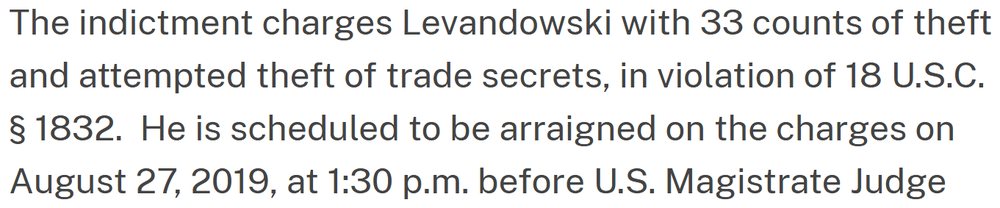
The arbitration was a civil matter. There was also a criminal one. On Aug. 27, 2019, federal prosecutors announced an indictment of Levandowski with 33 counts of "theft and attempted theft of trade secrets," in the words of the release. The U.S. Attorney said "Theft is not innovation." The release itself says an indictment merely alleges that crimes have been committed [4].
Swipe sideways to read the full line.
6:30
What was the one count?
Levandowski entered a plea in March 2020 to one count. Prosecutors agreed to dismiss the other 32, according to the Justice Department release [5].
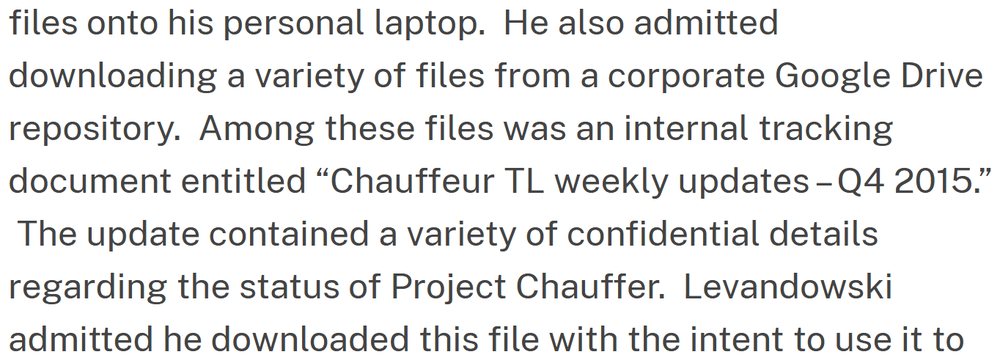
That one count was not about 14,000 files. In the plea, the release says, he admitted downloading thousands of files to his personal laptop. But the document named in the plea was one internal tracking file, a weekly status update from the end of 2015. He admitted that he downloaded it intending to benefit himself and Uber, and that a reasonable estimate of the loss was up to $1.5 million. We did not read the plea agreement; this is what the release says he admitted [5].
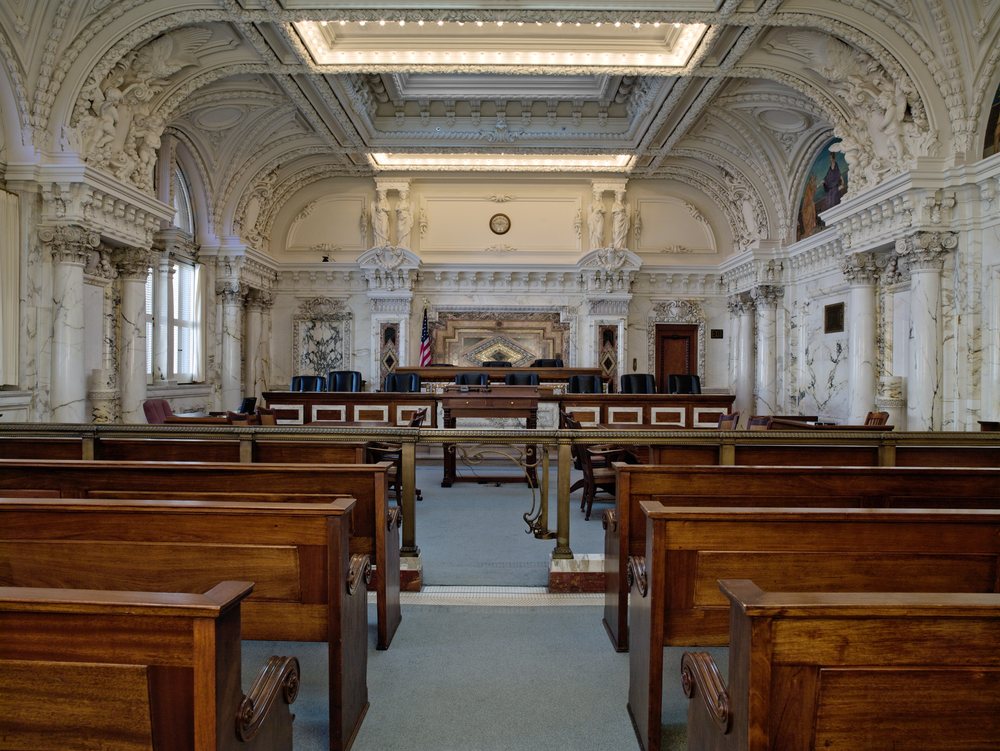
Prosecutors told the court his broader conduct was "brazen and shocking." On Aug. 4, 2020, Judge Alsup sentenced him to 18 months in prison, a $95,000 fine and $756,499.22 in restitution to Waymo. The release quotes the judge: "this is the biggest trade secret crime I have ever seen." It also says he would start serving on a date to be set, when risks from COVID had subsided [5].
Swipe sideways to read the full line.
8:05
What did the pardon say, and what are the two quotes?
In January 2021, as President Trump left office, a White House statement dated the 20th listed 143 clemency grants. One was a full pardon for Anthony Levandowski. The statement describes his case as "a single criminal count arising from civil litigation," and it quotes his sentencing judge calling him a "brilliant, groundbreaking engineer that our country needs." It names supporters, among them Peter Thiel and Palmer Luckey [6].
The same judge, the same sentencing. One day, the biggest trade secret crime he had ever seen. And, by the White House's account, a brilliant engineer his country needs. We did not find the hearing transcript, so the judge's remark is as the statement and the release quote it [5][6].
Swipe sideways to read the full line.
9:20
What is still open?
A pardon covers a criminal case. But Uber told investors in its next annual report that it still listed the Levandowski dispute, with a possible loss of up to $60 million or more, beyond what it had set aside. The criminal case was over. The money question was not [8].
Uber's annual report filed in early 2022 says that, in Levandowski's bankruptcy case, he and Uber had reached a confidential settlement in principle on their claims against each other. A court hearing to approve it was set for Mar. 3, 2022. The terms are confidential, and what happened at that hearing we could not find in a primary source [8].
So who built the technology? Google, starting in 2009, according to its complaint. Who took the files? A court found, for its provisional order, that 14,000 left Google's server, and Levandowski entered a plea to a single count. And who paid? Press reports put Uber's settlement with Waymo at around $245 million in stock. An arbitration panel gave Google $127 million against Levandowski in an interim award. Uber paid about $10 million for his former colleague's share. Levandowski was fined $95,000 and ordered to pay Waymo restitution [5][7][8][9].