Invention Heist

Versus · Nov. 27, 2026 · 11 min

The $909M Mistake That Killed Kodak's Instant Camera

Thumbnail of the video: The $909M Mistake That Killed Kodak's Instant Camera

Published Nov. 27, 2026

The short answer

  1. On Sept. 13, 1985, Judge Rya Zobel ruled that Kodak had infringed 20 claims of seven valid Polaroid patents. She ordered Kodak out of instant photography from Jan. 9, 1986, and the appeals court upheld the ruling in all respects [1][2].
  2. In 1990 a second judge, A. David Mazzone, set the damages at $909,457,567, about half of it interest. He also found that Kodak's infringement was not willful [3].
  3. Kodak's defense on that question was the advice of an outside patent lawyer. The judge wrote: "That advice simply turned out to be wrong." [3]
  4. The $925 million payment of July 1991 and the $873 million figure come from press reports, not from a court document we read [5].

Timeline of Polaroid v. Kodak

  1. Edwin Land begins work on what he calls one-step photography. [1]

  2. Land's process is first shown publicly, at a meeting of the Optical Society of America. [4]

  3. Polaroid's one-step camera goes on sale. The first pictures are sepia. [1]

  4. Polaroid and Kodak sign an agreement. Polaroid discloses its color technology, including dye developers, and Kodak helps make the film. [1]

  5. Polaroid tells Kodak about a radically new film. [1]

  6. Kodak ends the agreement and starts its own instant project, aimed at 1976. [1]

  7. Polaroid launches the SX-70. Land calls it "absolute one-step photography." [1]

  8. A Kodak development committee writes that development "should not be constrained by what an individual feels is potential patent infringement." [1]

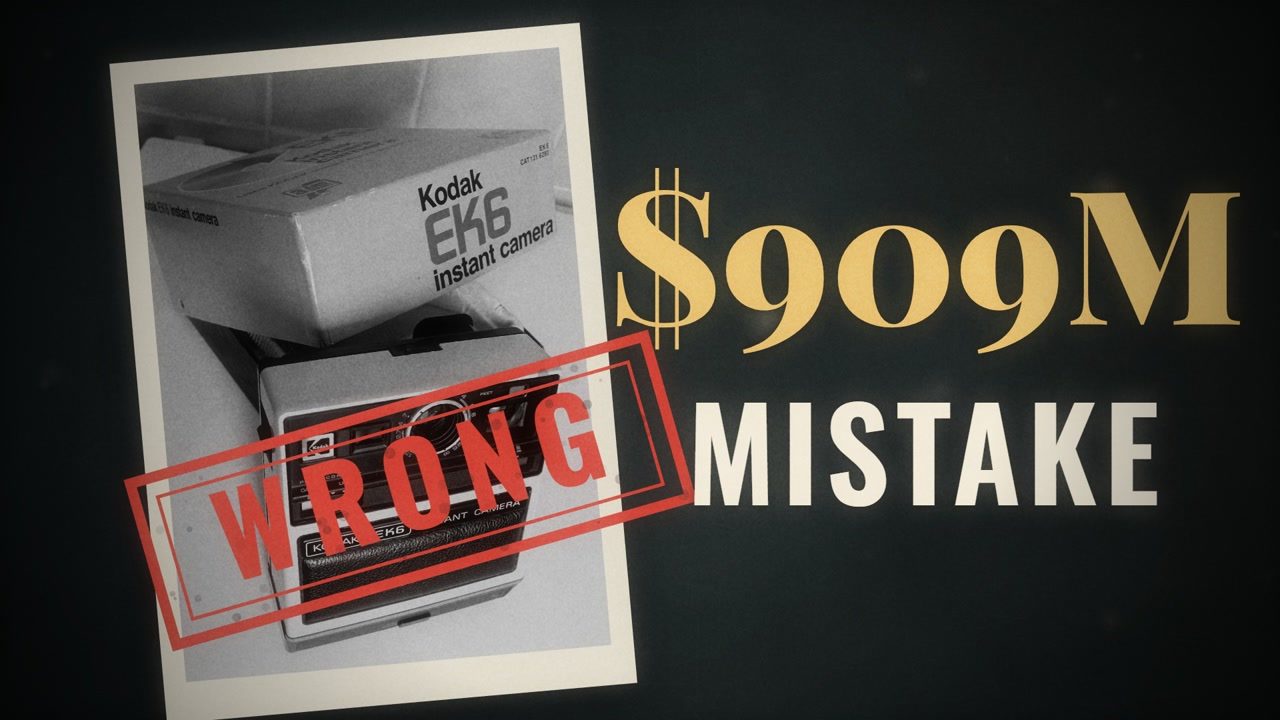
  9. Kodak launches the EK4 and EK6 instant cameras. [1]

  10. ReportedPolaroid files suit. TIME reports the filing at 4:59 in the afternoon, the day before Polaroid's shareholder meetings. [6]

  11. Kodak is selling the Handle to dealers at cost. [3]

  12. The trial begins. It runs 75 days, before Judge Rya Zobel. [2]

  13. Judge Zobel finds that Kodak infringed 20 claims of seven valid Polaroid patents. [1]

  14. The Federal Circuit denies Kodak's request to stay the injunction. [2]

  15. The injunction takes effect. [1]

  16. The Federal Circuit affirms the appealed portions of the judgment in all respects. [2]

  17. Judge A. David Mazzone sets the award at $909,457,567 and finds the infringement was not willful. [3]

  18. ReportedUPI reports that a clerical error cuts the figure to $873 million. [5]

  19. Edwin Land dies. [4]

  20. ReportedUPI reports that Kodak pays Polaroid $925 million. [5]

  21. Polaroid files for Chapter 11. [9]

  22. Kodak files for Chapter 11. [10]

Polaroid and Kodak, side by side

What each company says is the position of a party, not a finding. What the courts decided is in the table below.

Polaroid

What Polaroid says, as a party

  • Its founder told shareholders in 1976: "We took nothing from anybody." These are Land's words as TIME printed them [6].
  • According to UPI, it asked for $12 billion, three times its claimed losses, because it said Kodak had acted on purpose [5].
  • It argued that Kodak had used its outside patent lawyer as cover [3].

Kodak

What Kodak says, as a party

  • It denied knowingly breaking any valid patent, TIME reported in 1976 [6].
  • It alleged that the patents are invalid or unenforceable or both [1].
  • According to UPI, it said it owed no more than $200 million [5].
  • Its defense on willfulness was the opinions of an outside patent lawyer, who reviewed more than 250 patents and wrote 67 written opinions [3].

What the courts decided

WhenWho decidedWhat the document saysExhibit
Sept. 13, 1985Federal court in Massachusetts (Judge Zobel)Kodak infringed 20 claims of seven valid Polaroid patents.[1]
Jan. 7, 1986Federal Circuit, orderKodak's motion for a stay pending appeal is denied.[2]
Jan. 9, 1986Federal court in MassachusettsFrom this date Kodak is enjoined from infringing the patents listed in the judgment.[1]
Apr. 25, 1986Federal Circuit, opinion"We affirm the appealed portions of the judgment in all respects."[2]
Oct. 12, 1990Federal court in Massachusetts (Judge Mazzone)Kodak's infringement was not willful and deliberate. Damages of $454,205,801 plus interest of $455,251,766 make a total of $909,457,567. Costs are not taxed against either party.[3]

The case, chapter by chapter

0:00

What does it cost to lose one argument about a camera?

In July 1991, Eastman Kodak paid its smaller rival, Polaroid, $925 million, according to UPI [5]. Five years earlier, a federal judge had ordered Kodak to stop making instant cameras and instant film [1].

Kodak had sold about 16.5 million of those cameras, according to the Los Angeles Times [7]. Overnight, every one of them became a camera with no future.

Three questions run through the case. Who invented the instant picture? Who brought it to market? And who, in the end, actually won? The answer is in a court ruling from 1990 [3].

0:51

Who invented the instant picture?

As the National Academy of Sciences tells it, Edwin Land's three-year-old daughter asked him in the mid 1940s why she had to wait: "Why can't I see the picture now?" The memoir reports her words. They were not recorded [4].

Land was already an inventor, with a company in Cambridge, Massachusetts, built on polarized light. It was called Polaroid. In 1944 he began work on what he called one-step photography. In February 1947 he showed it to a room full of scientists, and in December 1948 it went on sale [1][4].

The first pictures were sepia, and messy. You had to peel the print away from a chemical sheet and coat it [1][3].
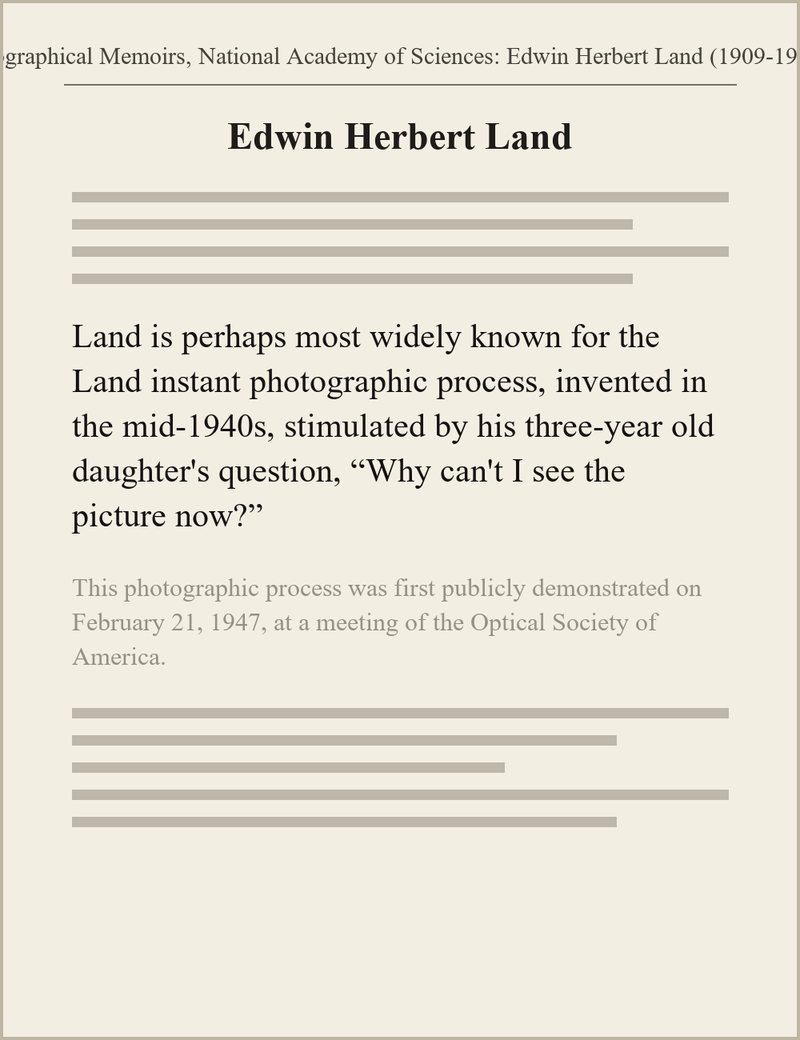
Excerpt of a document: Typed card reproducing a passage of the National Academy of Sciences memoir of Edwin Herbert Land. Not a scan.
Exhibit 4Typed card reproducing a passage of the National Academy of Sciences memoir of Edwin Herbert Land. Not a scan.

Swipe sideways to read the full line.

1:42

Why was Kodak Polaroid's partner before it was a rival?

From the early 1950s, the negative inside Polaroid's film came from Kodak [1]. In December 1957 the two companies signed an agreement. Polaroid shared its color technology with Kodak, including a new chemistry called dye developers, and Kodak helped make the film [1].

For eleven years the deal held. In April 1968, Polaroid told Kodak about a radically new film. In April 1969 Kodak ended the agreement, and that year it started a project of its own: an instant color print on the market by 1976 [1].

Kodak was not a small rival. In 1975 its sales were about $5 billion, and Polaroid's whole instant business was about $800 million a year, according to TIME [6].
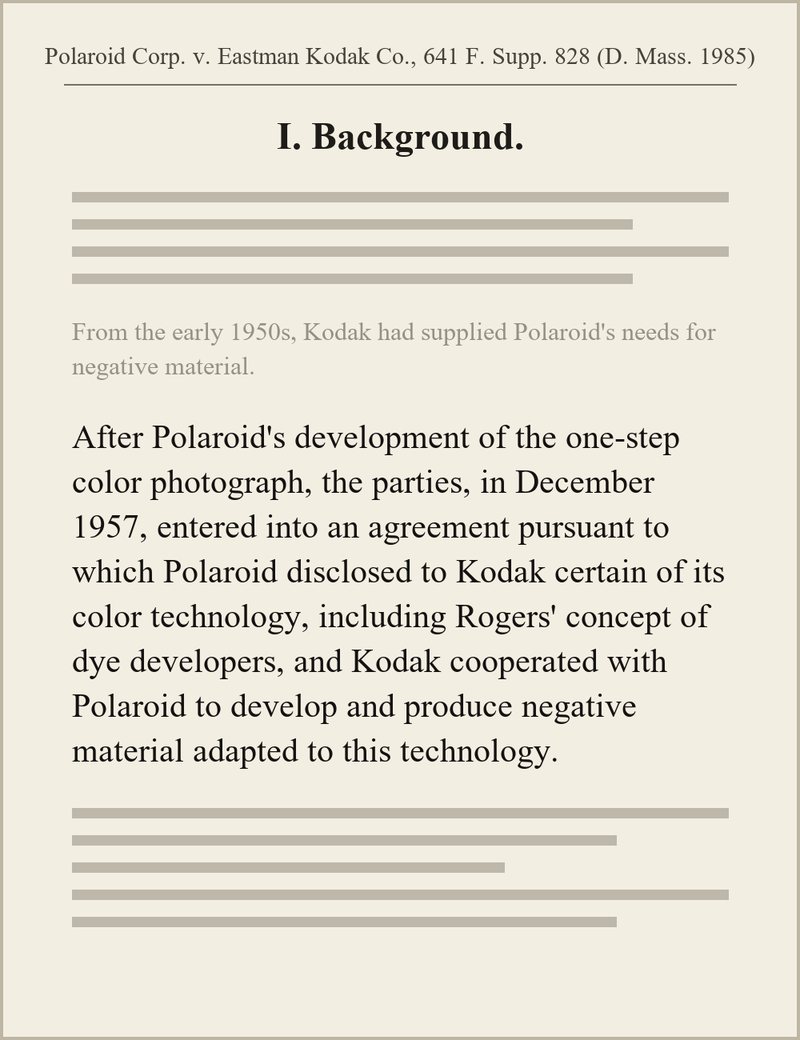
Excerpt of a document: Typed card reproducing a passage of 641 F. Supp. 828 (1985), part I: the agreement of December 1957. Not a scan; the full opinion is linked in the exhibit list.
Exhibit 1Typed card reproducing a passage of 641 F. Supp. 828 (1985), part I: the agreement of December 1957. Not a scan; the full opinion is linked in the exhibit list.

Swipe sideways to read the full line.

2:37

What was the SX-70, and why did Kodak's first plan fall apart?

In 1972 Polaroid launched the SX-70. Land called it "absolute one-step photography." The picture developed in daylight, with no peeling. It made the cover of Time and the cover of Life [1][3].

In 1974 Polaroid sold almost a million of them, a record for a camera priced over $100. It still did not earn a satisfactory profit, and by 1976 it had invested about $600 million in the SX-70 [3].

Inside Kodak, the plan fell apart. Its own camera, nicknamed the Lanyard, was suddenly too big, and a Kodak committee found the program "no longer desirable." A second project, a film for Polaroid's own cameras, was dropped toward the end of 1972 after costing $94 million [1]. Kodak went bigger: at the peak, between 1,300 and 1,400 people were assigned to its instant system [1].

In October 1972 Kodak bought SX-70 cameras and film in large quantities. Its teams were told to study them and test them. The court called this undisputed [1].
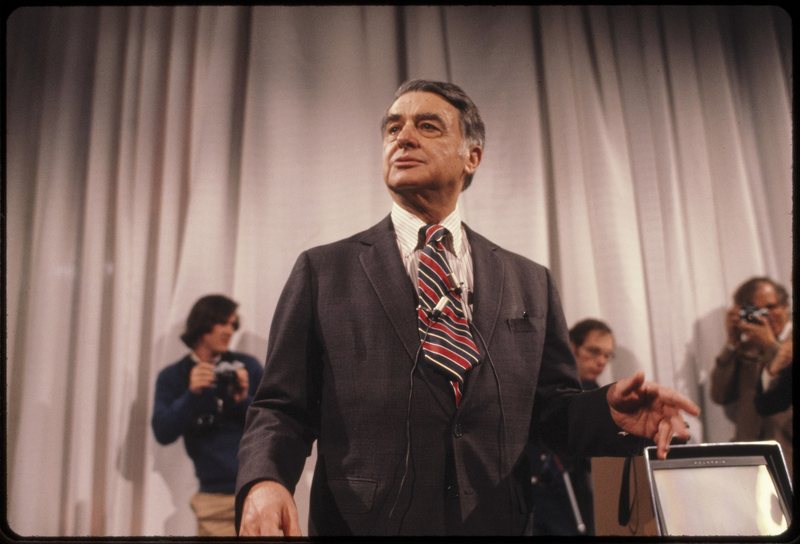
Edwin H. Land at a Polaroid presentation in 1971
Edwin H. Land at a Polaroid presentation, 1971. Photo: Bernard Gotfryd, Library of Congress, public domain, via Wikimedia Commons.

3:56

What sentence did Kodak's committee put on paper in 1973?

In September 1973, a Kodak committee wrote one sentence: "Development should not be constrained by what an individual feels is potential patent infringement." [1]

Judge Zobel quoted it in her 1985 ruling. She wrote that it was by no means decisive on the question of infringement of any particular patent. But she put it in the ruling [1].
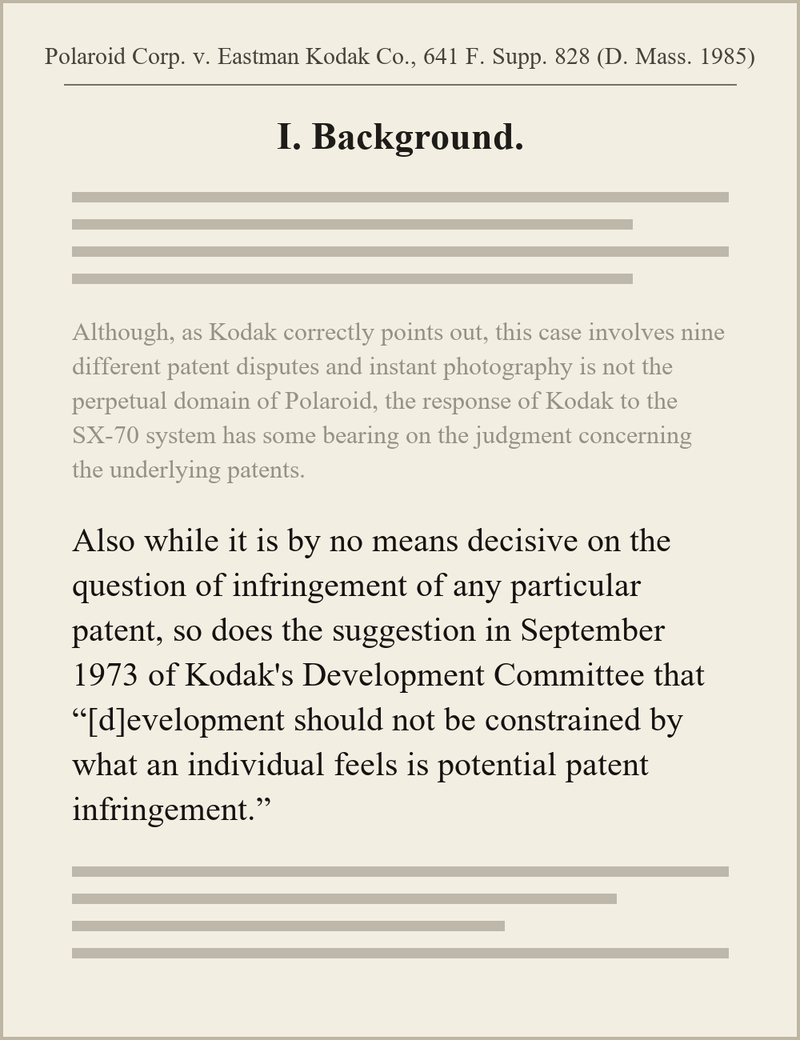
Excerpt of a document: Typed card reproducing a passage of 641 F. Supp. 828 (1985), part I: the sentence of September 1973. Not a scan.
Exhibit 1Typed card reproducing a passage of 641 F. Supp. 828 (1985), part I: the sentence of September 1973. Not a scan.

Swipe sideways to read the full line.

4:12

How did the fight move from the courtroom to the stores?

In April 1976 Kodak launched its instant cameras, the EK4 and the EK6, with its own film [1]. Polaroid had seen it coming since 1970 [3]. Polaroid filed suit on April 26 [2]. TIME reported that the filing came at 4:59 in the afternoon [6].

The next day Land stood in front of his shareholders. "We took nothing from anybody," he said. "The only thing keeping us alive is our brilliance." And: "The only thing that keeps our brilliance alive is our patents." The room cheered, TIME reported, and Kodak denied knowingly breaking any valid patent [6]. These are Land's words as TIME printed them in 1976. They are not a court finding.

In 1976 Kodak sold about 500,000 EK4s and 600,000 EK6s. Polaroid's new Pronto sold almost 1.8 million [3]. In 1977 Kodak announced a cheap camera that people called the Handle. Inside Polaroid, the court later found, it landed like a "bombshell." Polaroid answered with the OneStep, its best-selling camera ever [3].

Kodak also sold about four million cameras as promotional gifts and prizes, and the court found they were sold at a considerable loss. By July 1978 Kodak was selling the Handle to dealers at cost. Prices fell, and so did margins [3]. In 1979 Polaroid laid off about 800 workers, and Kodak had still not made a profit on instant photography [3].

In 1980 Polaroid rushed out a faster film, Time Zero. One of its executives later testified that the urgency came from Land's insistence on the need "to beat Kodak" [3].

6:08

Why did the court take so long?

The lawsuit crawled. There were five years of pretrial fighting and more than a thousand entries in the court record. The trial began in October 1981 and ran 75 days, before Judge Rya Zobel [2].

Then came a wait of three and a half years for her decision. By the time it came, Kodak had already decided, in 1984, to pull out of the consumer market [3].

6:36

What did Judge Zobel rule in 1985?

On Sept. 13, 1985, Judge Zobel ruled that Kodak had infringed 20 claims of seven valid Polaroid patents [1][3]. According to the 1990 ruling, Kodak lost $600 million on instant photography [3]. She ordered Kodak out of the business, starting Jan. 9, 1986 [1].

Kodak asked the appeals court to wait. The request was denied [2]. According to a 1986 news report based on Kodak's documents, the order would cost hundreds of jobs and leave $200 million of equipment idle [8]. The owners of those 16.5 million cameras were offered a trade, or Kodak shares, as the Los Angeles Times reported at the time [7].

The appeals court upheld the ruling in all respects. The Supreme Court declined to hear the case [2][3].
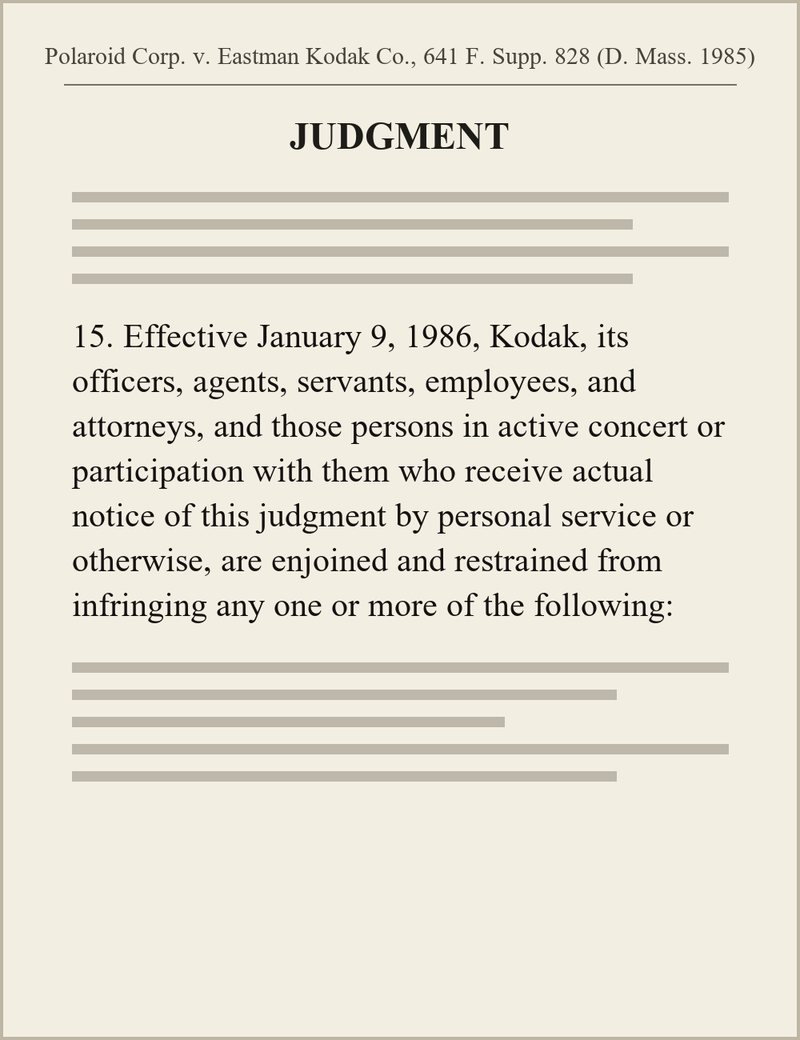
Excerpt of a document: Typed card reproducing a passage of the judgment in 641 F. Supp. 828 (1985): the injunction effective Jan. 9, 1986. Not a scan.
Exhibit 1Typed card reproducing a passage of the judgment in 641 F. Supp. 828 (1985): the injunction effective Jan. 9, 1986. Not a scan.

Swipe sideways to read the full line.
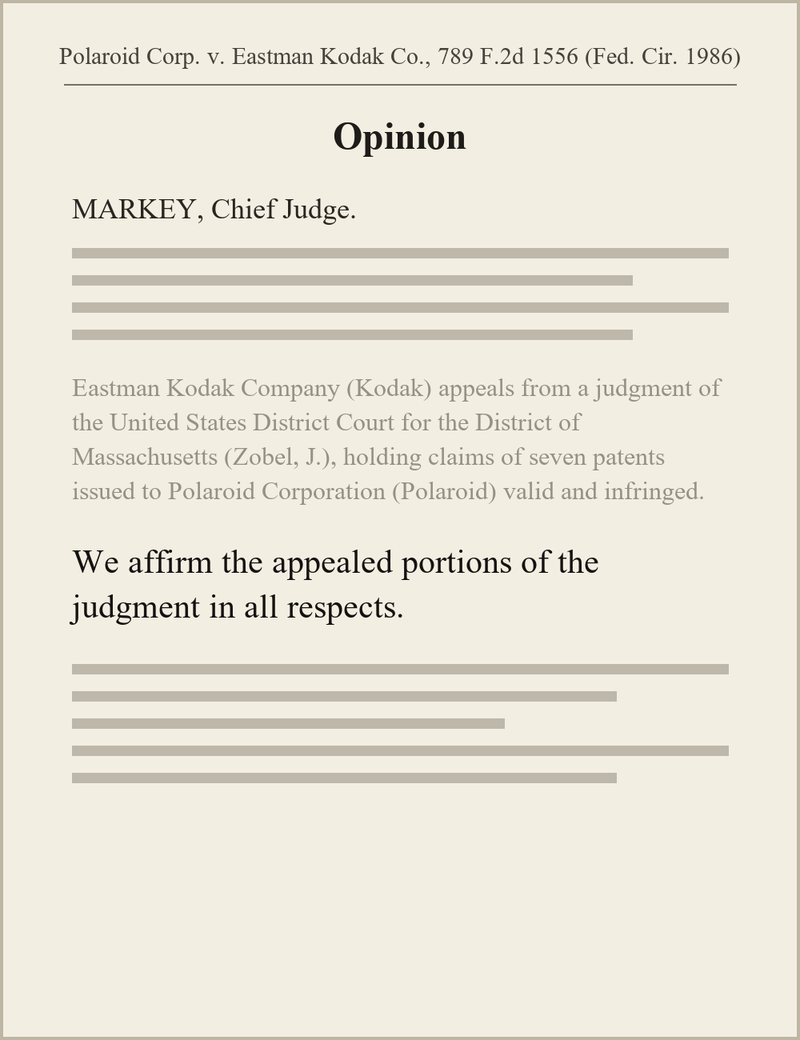
Excerpt of a document: Typed card reproducing the opinion of the Federal Circuit in 789 F.2d 1556 (1986). Not a scan.
Exhibit 2Typed card reproducing the opinion of the Federal Circuit in 789 F.2d 1556 (1986). Not a scan.

Swipe sideways to read the full line.
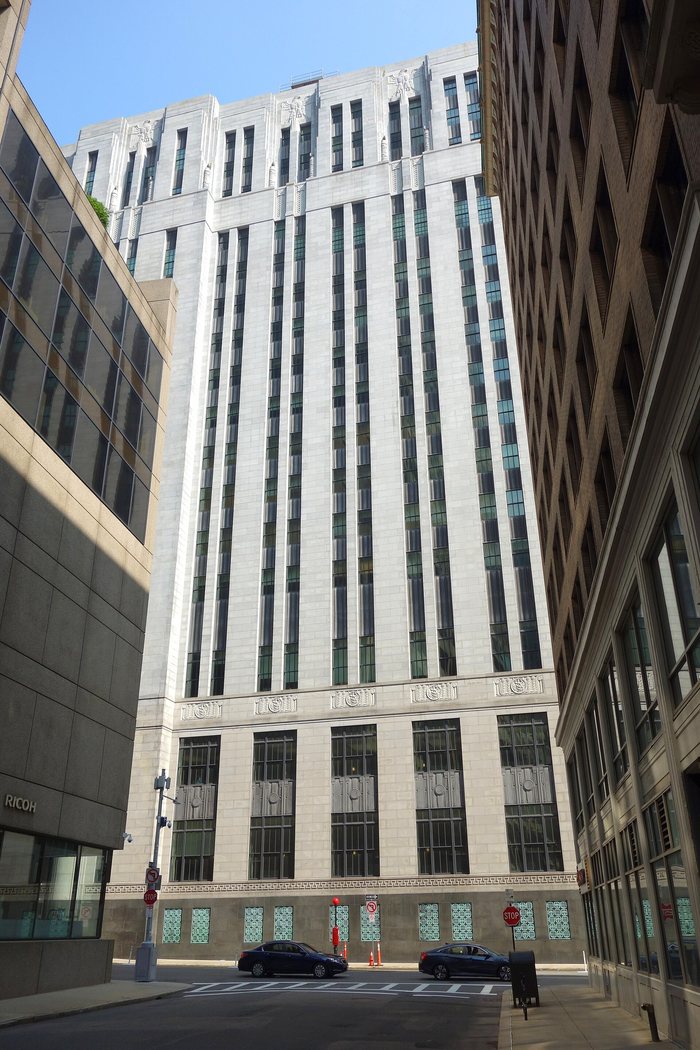
A federal courthouse in Boston, marked as an illustration
ILLUSTRATION: the John W. McCormack Post Office and Courthouse in Boston, shown as a federal courthouse. We have not verified that the trial was held there. Photo: Daderot, public domain, via Wikimedia Commons.

7:36

How much did Kodak owe?

One question was still open: how much? According to UPI, Polaroid asked for $12 billion, three times its claimed losses, because it said Kodak had acted on purpose. Kodak said it owed no more than $200 million [5].

A second trial began, before Judge A. David Mazzone. It lasted 96 days. Experts tried to rebuild, in the judge's words, "a world that never existed," a world without Kodak [3]. Polaroid's own expert said that, in that world, Polaroid would have made over $3.9 billion, with interest [3].
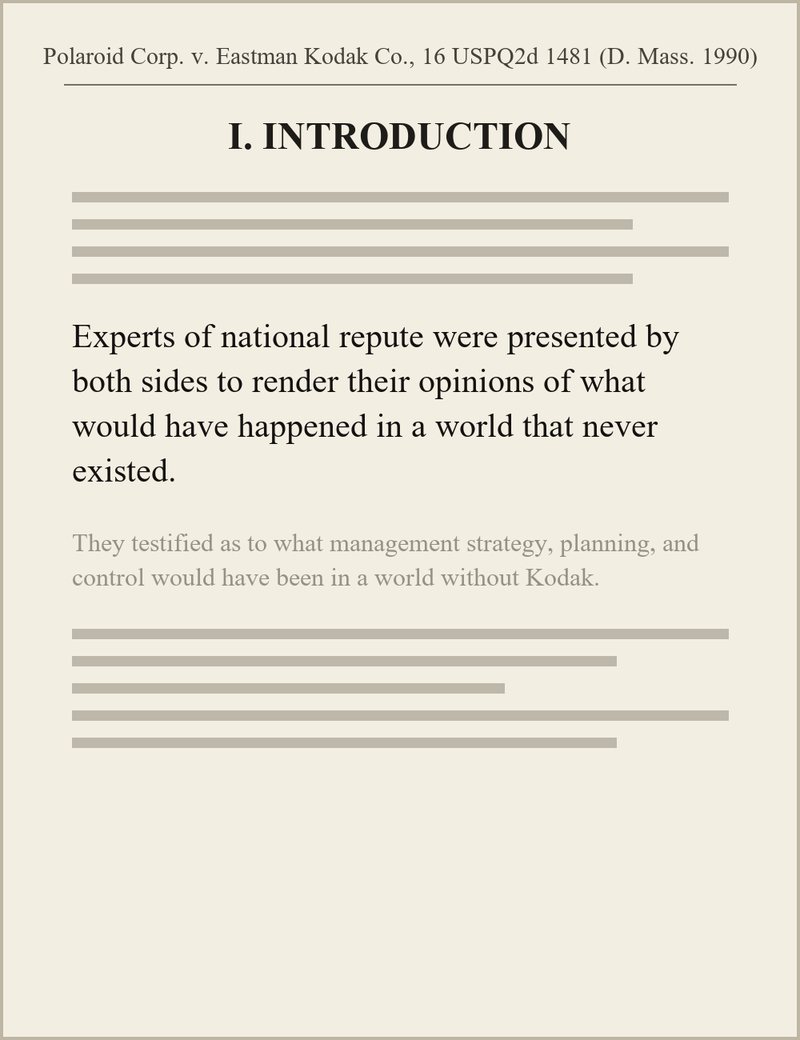
Excerpt of a document: Typed card reproducing a passage of 16 USPQ2d 1481 (1990), part I: "a world that never existed." Not a scan.
Exhibit 3Typed card reproducing a passage of 16 USPQ2d 1481 (1990), part I: "a world that never existed." Not a scan.

Swipe sideways to read the full line.

8:19

Did Kodak infringe on purpose?

Everything came down to that question. Kodak's defense was one man: an outside patent lawyer, retained seven years before its first commercial instant product. In the court's words, he considered over 250 patents and rendered 67 written opinions [3]. Polaroid argued that Kodak had used him as cover [3].

The judge's reply was: "That dog will not hunt." He found no willful infringement. There were no triple damages and no legal fees [3].

About one of the patents, he wrote: "That advice simply turned out to be wrong." [3]
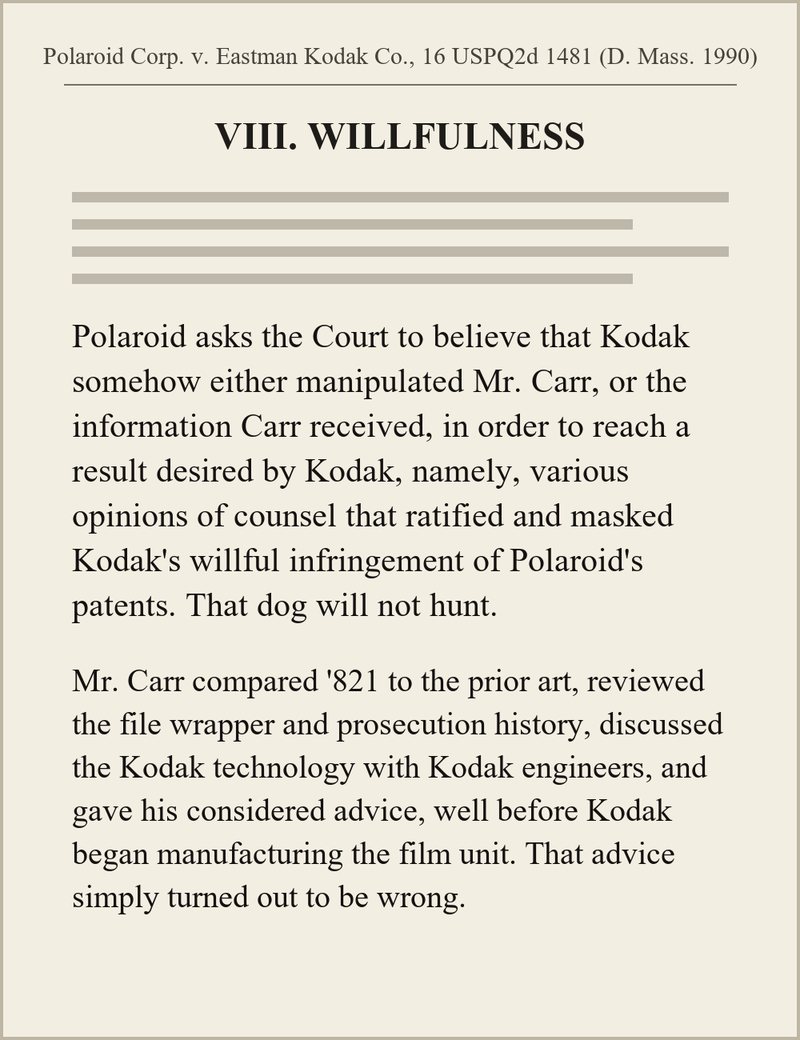
Excerpt of a document: Typed card reproducing a passage of 16 USPQ2d 1481 (1990), part VIII. Not a scan; the ruling was read on an unofficial copy, linked in the exhibit list.
Exhibit 3Typed card reproducing a passage of 16 USPQ2d 1481 (1990), part VIII. Not a scan; the ruling was read on an unofficial copy, linked in the exhibit list.

Swipe sideways to read the full line.

8:59

What was the final bill?

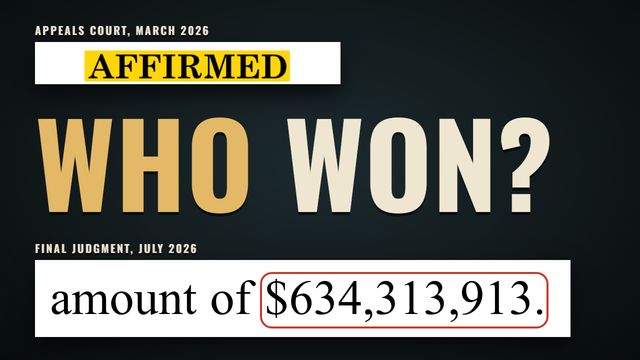
On Oct. 12, 1990, the bill was $909,457,567: $454,205,801 in damages and $455,251,766 in interest, so about half of it was interest [3]. In January 1991, UPI reported, a clerical error cut it to $873 million. In July 1991, with more interest, Kodak paid $925 million [5]. We did not read the amended judgment: the $873 million and $925 million figures come from UPI alone.

Edwin Land was alive when the 1990 ruling came. He died on March 1, 1991. Kodak paid four months later [4][5].
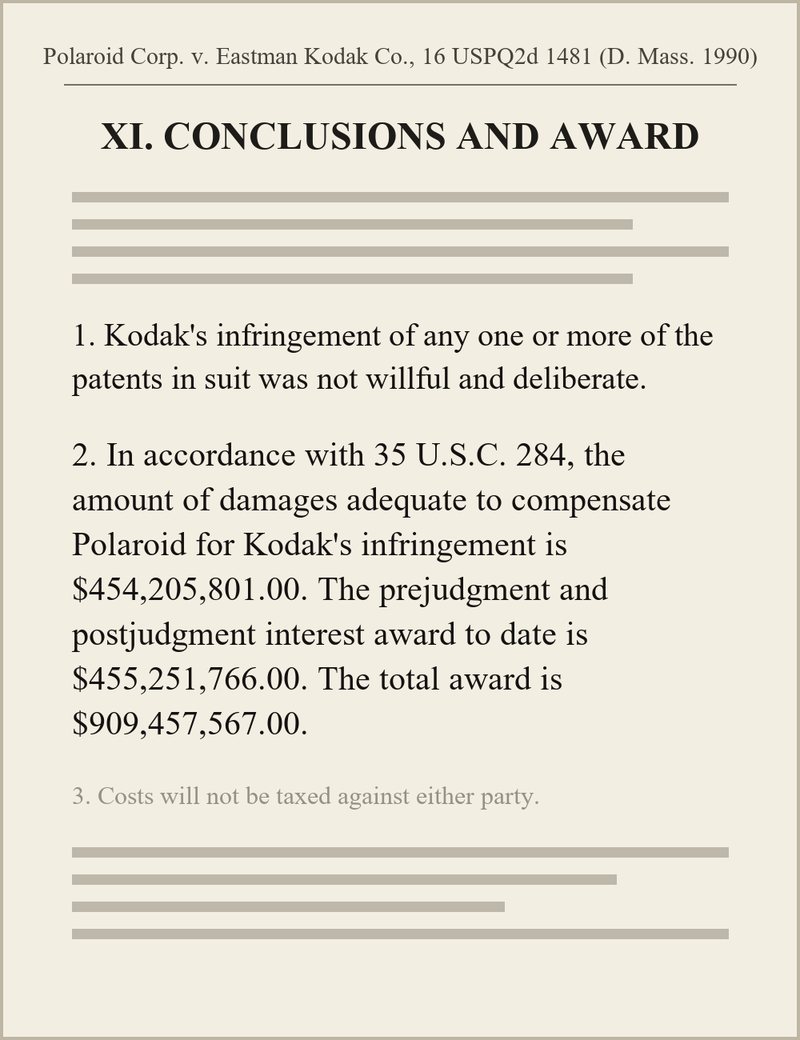
Excerpt of a document: Typed card reproducing the conclusions of 16 USPQ2d 1481 (1990), part XI: the award. Not a scan.
Exhibit 3Typed card reproducing the conclusions of 16 USPQ2d 1481 (1990), part XI: the award. Not a scan.

Swipe sideways to read the full line.

9:21

What was the mistake?

The same 1990 ruling had already recorded a warning. In 1981, Polaroid's chief executive said: "It is 35mm sales that have grown at the expense of instant." [3]

Polaroid filed for Chapter 11 on Oct. 12, 2001, ten years after the check. Kodak followed in January 2012 [9][10].

So what was the $909 million mistake? Not a plan to cheat: the court found that Kodak's infringement was not willful [3]. It was an outside lawyer's advice about Polaroid's patents. On one of them, the court said the advice was wrong [3]. Polaroid won the case. Neither company won what came next.
Questions people ask

Who was Edwin Land?

Land was an inventor with a company in Cambridge, Massachusetts, built on polarized light. He began work on one-step photography in 1944, and Polaroid's camera went on sale in December 1948. He died on March 1, 1991 [1][4].

Did Kodak ever make a profit on instant photography?

By 1979 Kodak had still not made a profit on instant photography, and the 1990 ruling says it lost $600 million on it [3].

Did the Supreme Court hear Polaroid v. Kodak?

No. The appeals court upheld the ruling in all respects, and the Supreme Court declined to hear the case [2][3].

What happened to the owners of Kodak's instant cameras?

The Los Angeles Times reported that Kodak had sold about 16.5 million of the cameras and that their owners were offered a trade, or Kodak shares. That figure rests on one source [7].

What happened to Polaroid and Kodak after the case?

Polaroid filed for Chapter 11 on Oct. 12, 2001, and Kodak filed on Jan. 19, 2012 [9][10].

The exhibits

Every source used in the film, numbered as in the video description. Eleven sources, plus the documents we could not read.

  1. 1Polaroid Corp. v. Eastman Kodak Co., 641 F. Supp. 828 (D. Mass. 1985), Judge Zobel, memorandum of decision and judgment (background and judgment read in full)static.case.law Read at the source
  2. 2Polaroid Corp. v. Eastman Kodak Co., 789 F.2d 1556 (Fed. Cir. 1986), appeal, and 833 F.2d 930, order denying a staystatic.case.law (1) static.case.law (2) Read at the source
  3. 3Polaroid Corp. v. Eastman Kodak Co., 16 USPQ2d 1481 (D. Mass. Oct. 12, 1990), Judge Mazzone, damages (introduction, overview, willfulness and conclusion read in full; unofficial copy)patenting-art.com Read, unofficial copy
  4. 4National Academy of Sciences, Biographical Memoirs, "Edwin Herbert Land"books.nap.edu Read at the source
  5. 5UPI, "Polaroid, Kodak settle patent suit," July 15, 1991upi.com Reported
  6. 6TIME, "Photography: Polaroid Sues Kodak," May 10, 1976time.com Reported
  7. 7Los Angeles Times (D. Gellene), "Ruling Forces Kodak to Quit Instant Camera Field; Recall Launched," Jan. 9, 1986 (copy posted at Collectors Weekly)collectorsweekly.com Reported
  8. 8NZPA-AP, "Kodak goes out of instant," The Press, Jan. 10, 1986paperspast.natlib.govt.nz Reported
  9. 9Polaroid Corporation Form 8-K, Oct. 12, 2001 (Chapter 11)sec.gov Read at the source
  10. 10Eastman Kodak Company Form 8-K, Jan. 19, 2012 (Chapter 11)sec.gov Read at the source
  11. 11U.S. patents 3,245,789, 3,362,821, 3,753,392, 3,810,211 (Polaroid) and 4,131,919 (Kodak), Google Patents. Shown in the film, not on this page.Read at the source

Not read

  • The amended judgment of January 1991, known only through UPI.
  • Parts III to VII, IX and X of the 1990 damages ruling, which we searched by keyword but did not read in full.
  • The patent-by-patent analysis of the 1985 ruling, except part of one patent.
  • The Los Angeles Times original of Jan. 9, 1986, read on a copy posted at Collectors Weekly.
  • The text of U.S. Patent 4,131,919, of which only the title, dates and inventors were read.

What this does and does not show

  • The 1985 ruling, the injunction, the appeal and the 1990 damages award of $909,457,567 are read in court documents [1][2][3].
  • The 1990 ruling found that Kodak's infringement was not willful. This page does not say that anyone acted in bad faith [3].
  • The $925 million payment and the $873 million figure come from UPI alone. We did not read the amended judgment [5].
  • The 16.5 million cameras and the exchange offer come from the Los Angeles Times, read on a copy posted online. The job and equipment figures come from a 1986 wire report. Polaroid's request for $12 billion comes from UPI [5][7][8].
  • Land's remarks to shareholders in 1976 are as TIME printed them [6].
  • We read the 1990 damages ruling on an unofficial copy, and only parts of it in full: the introduction, the overview, the willfulness section and the conclusion [3].

The channel reports what the documents say; it does not decide the case.

Credits

Photos via Wikimedia Commons: Edwin H. Land, 1971, Bernard Gotfryd, Library of Congress, public domain; the John W. McCormack Post Office and Courthouse in Boston, Daderot, public domain (marked ILLUSTRATION). The other photos of the film, cameras and a tower, are not shown on this page. Court pages are typeset for this film from the exact text of the decisions and the memoir, and are labeled as typed cards.

Music: YouTube Audio Library (no attribution required): "Event Horizon", "False Vacuum Decay", "Pulsar", "Rapid Unscheduled Disassembly" (The Grey Room / Density & Time) and "From Here on In" (Everet Almond). Sound effects: Pixabay (Pixabay Content License).

Narration is AI-generated from an original script. Every document shown is a real public record or a labeled typed card. People appear only in real photographs. The film uses no AI-generated images. This film does not claim that anyone acted in bad faith.