The case, chapter by chapter
0:00
How does a Nobel winner lose a patent fight?
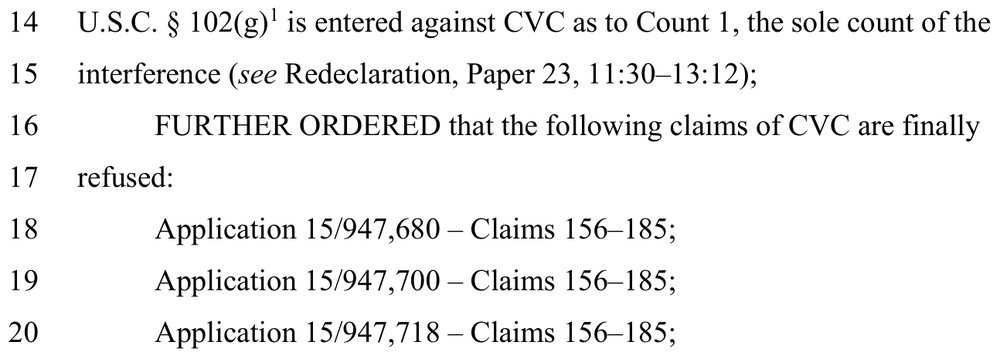
On Oct. 7, 2020, the Nobel Prize in Chemistry went to Emmanuelle Charpentier and Jennifer Doudna "for the development of a method for genome editing" [5]. On Mar. 26, 2026, a patent board entered judgment against the side they are on, led by the University of California. It finally refused claims in fourteen of that side's patent applications [3].
Did the patent office decide that someone else invented CRISPR? Not exactly. The ruling is narrower than that. Inside it are a race measured in weeks, a court that told the patent office it used the wrong test, and one word in an email dated Oct. 11, 2012. Three questions run through the case. What did the Nobel Prize reward? What did the board actually decide? And what is still open?
1:06
What is CRISPR, in one minute?
Bacteria have an ancient defense against viruses. They cut the invader's DNA. CRISPR is that system. The cutting is done by a protein called Cas9, steered by a small piece of RNA. In 2012, Charpentier and Doudna showed that the steering could be reprogrammed. In a test tube, the scissors could cut any DNA at a chosen spot [5].
A test tube is not a living cell. Animals and plants are built from cells with a nucleus, called eukaryotic cells. Bacteria are not [1]. Would the scissors work inside one? A court would later write that the technology was highly unpredictable and complex, and neither side challenged that [1].
The system first used two pieces of RNA. Fusing them into one makes a single guide. A single guide, working in a cell with a nucleus, is the invention both sides are fighting over [1][2].
2:20
How does a patent fight like this work?
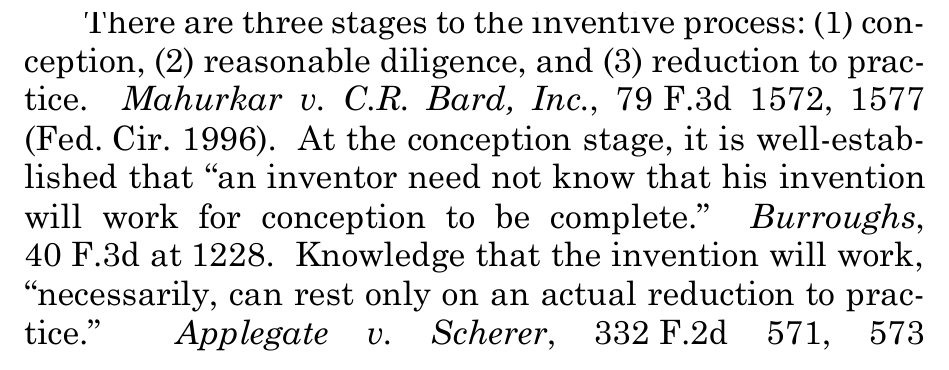
For applications filed before March 2013, a patent went to the first to invent, not the first to file. When two parties claim the same invention, the patent board runs a contest called an interference. It uses two words. Conception: the idea, formed so clearly that only ordinary skill is needed to carry it out. Reduction to practice: a version that works [1].
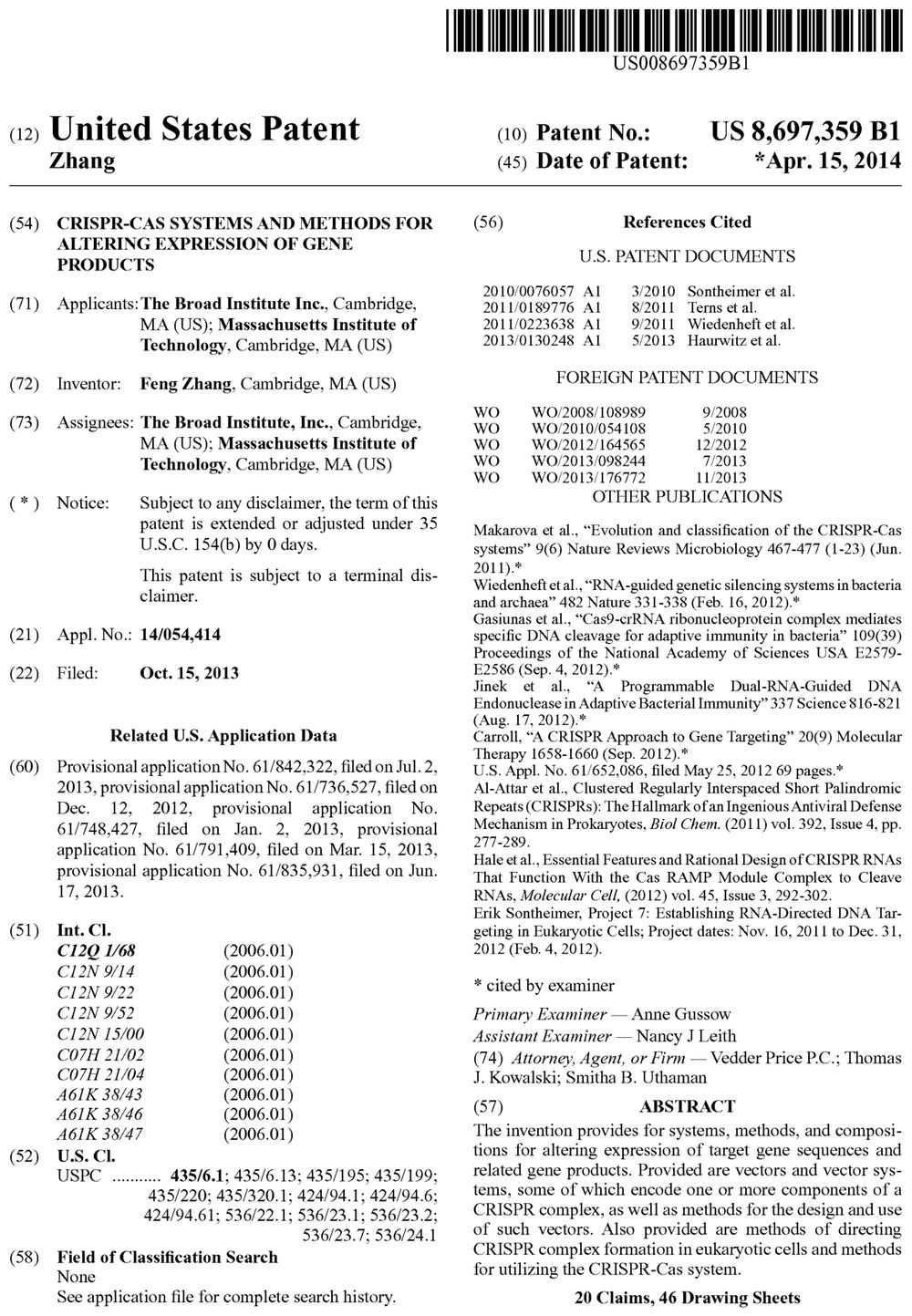
On one side, the University of California, the University of Vienna and Charpentier. On the other, the Broad Institute, MIT and Harvard. California is the junior party. The patent at the center belongs to Broad and MIT: U.S. Patent 8,697,359. It names Feng Zhang as the inventor and was issued on Apr. 15, 2014 [1][4].
Here is the strange part. California filed first, on May 25, 2012. Broad's earliest provisional came on Dec. 12, 2012. So why is California the junior party? Hold that question [1][4].
Swipe sideways to read the full line.
3:33
What do the two timelines of 2012 show?
On June 21, 2012, California's team presents at a conference in Berkeley, and days later it publishes in Science. The paper shows cutting in a test tube. California does not dispute that it did not show cutting in a cell with a nucleus [1].
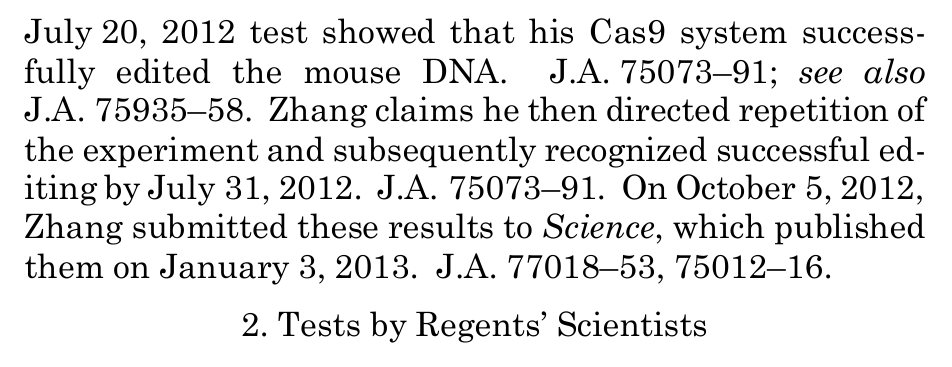
At the Broad, Feng Zhang says he learned of the system on June 26, 2012 and planned tests that day. He says he edited mouse cells in July. On Oct. 5 he sent his results to Science, which published them on Jan. 3, 2013. The board treats Oct. 5 as Broad's date for a working version [1].
In California's labs, in August, a fish experiment shows one possible edited embryo out of about thirty, according to the researcher who ran it. The next day a colleague emails Charpentier that it "might work but we shouldn't be overexcited now." In human cells, Doudna calls an August result "very exciting," but the next reports, dated Aug. 16, Sept. 14 and Oct. 10, show no evidence of editing [1].
Swipe sideways to read the full line.
4:47
What did the board decide in 2022, and what did the appeal say in 2025?
On Oct. 19, 2012, California files a second provisional application. Doudna says a student reported success ten days later, twenty-four days after Zhang's submission [1].
On Feb. 28, 2022 the board chose. Broad had priority. California had not proven it conceived the invention before Oct. 5, 2012. The board leaned on the doubts, the failed tests and the email of Oct. 11, in which Doudna called the latest results "disappointing." We have not read that decision. We know it through the Federal Circuit [1].
California appealed. On May 12, 2025, the Federal Circuit said the board had used the wrong test. It had mixed up conception and reduction to practice. Conception needs a definite idea, not proof that the idea works. In the court's words, an inventor "need not know that his invention will work" [1].
Swipe sideways to read the full line.
6:05
What was the wrong test, and what did the second decision say?
Doubts and failed experiments, the court said, do not settle the question alone. The board also had to ask whether routine methods, and the success of other labs, showed the idea was complete. The court vacated that part and sent it back. The same opinion upheld something else: California's first two applications did not describe a system that works in cells with a nucleus. The court never said who was first [1].
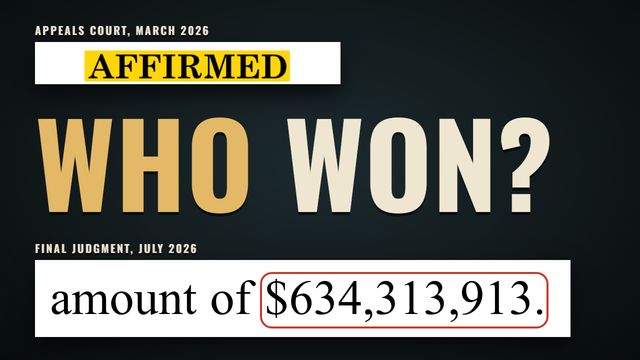
On Mar. 26, 2026, three judges decided again. They looked at routine methods, and at the labs that had succeeded. The board found that the labs that reported early success, among them Zhang's and George Church's, were more capable than an ordinary researcher. An ordinary researcher would have needed instruction, or "extensive research or experimentation." California's own team, the board wrote, was "still identifying significant aspects of the invention" after Broad had a working version [2].
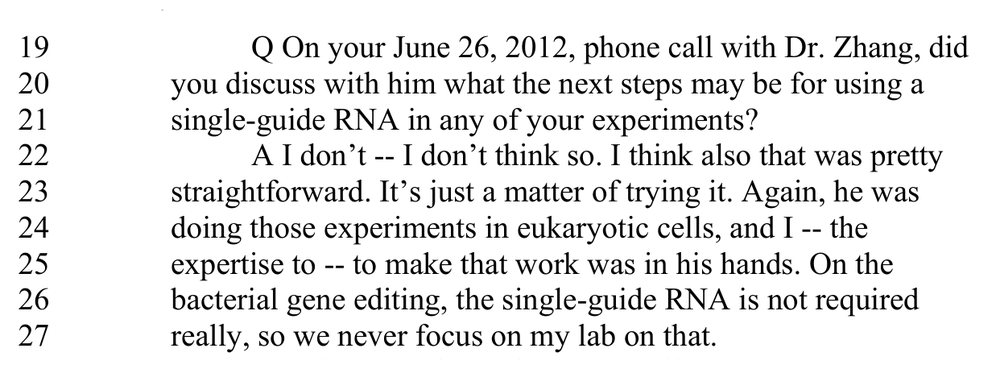
California pointed to Marraffini's testimony that trying it in cells was "just a matter of trying it," but the same testimony said the expertise to make it work was in Zhang's hands [2]. Same result, new test. On the argument that Zhang learned a key detail from a peer reviewer, the board did not need to settle it: to prove it, California first had to show that it had the complete invention [2].
Swipe sideways to read the full line.
7:30
What does the ruling not say?
This ruling does not say who discovered CRISPR. It does not even cover everything California filed. In 2018 the Federal Circuit had already looked at this fight. It agreed with the board that California's claims, which put no limit on where the DNA is cut, and Broad's claims, which cover a cell with a nucleus, are different inventions. That first interference ended with no ruling on who was first [1][2].
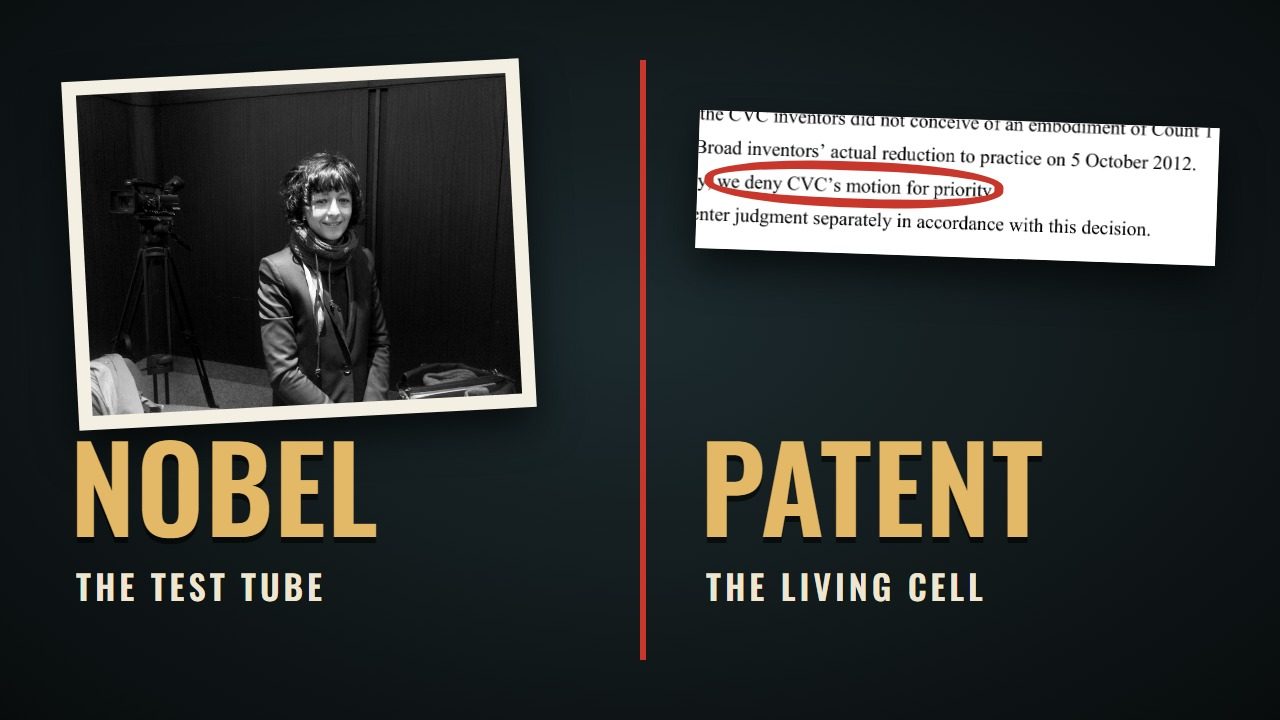
Go back to the Nobel announcement. It says Charpentier and Doudna recreated the scissors in a test tube, and showed they could cut any DNA at a chosen spot. The prize describes the test tube. This fight is about the cell [5].
The judgment covers one count, the sole count of this interference [3].
Swipe sideways to read the full line.
8:55
What is still open?
That one count carries money. After the 2022 ruling, Vertex agreed to pay Editas, which shares such payments with the Broad Institute, $50 million up front for a license, with up to $50 million more, according to BioPharma Dive. We could not find the value of the patents themselves, and we will not guess it [6].
California filed a notice of appeal in May 2026, according to a law firm that follows the case. As of Nov. 21, 2026, we found no ruling on it, and we did not check the Federal Circuit's own docket. Two other fights, with ToolGen and Sigma-Aldrich, are paused until this one ends [6].
A prize rewards a discovery. A patent rewards one claim at a time. On this claim, a patent board has now ruled for Broad twice, and the side the Nobel winners are on is appealing.